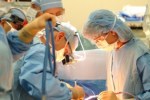
First Workout Post Surgery

I am sitting here at my computer breathing slightly hard. During my post-op visit yesterday my surgeon said I could start light workouts. Considering how badly my surgery knocked me on my ass I took him very seriously.

So I sat down about half an hour ago at my workout bench and did the following exercises:

  1. Rows, 5 sets of 10. 50lbs weight. Alternated underhand and overhand.
    These were really easy and I didn’t feel like I was working out at all. But as my doctor suggested, I kept the weight low.

  2. One Armed Curls, 3 sets each arm. 30lbs weight.
    These were also really easy and I had no problems.

  3. Bench Press, 3 sets. 50lbs.
    This is where it started to get interesting. As I did the bench press, I noticed a warm feeling in my neck, right where the neck muscle that was taken used to be. I also noticed a tightening in my left shoulder. Still, all in all, it was not that hard.

  4. Arm raises, never finished, 10lbs.
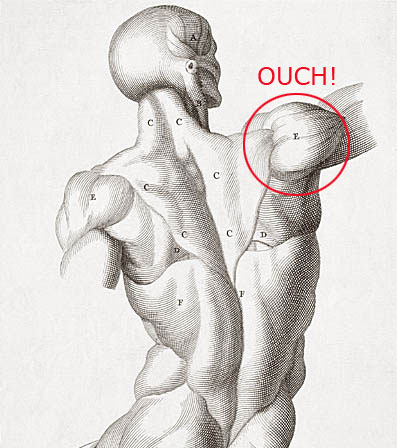
    This is where I immediately hit failure. Remember, in a previous blog I said that my surgeon had to move a nerve that controlled my left shoulder to get to the cancer. He told me I would have some weakness as a result.

    No shit! With my left had at my side and with a 10lb weight I could not lift the weight more than a foot before my shoulder gave out on me. So I lowered it to 5lbs and barely got any higher. I grabbed a 2.5lb weight and managed to get it and my arm parallel to the ground but no higher. I cannot list my arm higher than my shoulder right now in a stiff-arm raise.


Pretty crazy stuff. To top it off, when I came in Carey said my scar was glowing red. I forgot that blood rushes really show up on scars and since my is so new it looks very wicked.

Still, for a 20-minute workout it’s a start. Tomorrow I’ll try again and, knowing my limitations now, I’ll target the workout to address my weak area.

Living with Cancer – Understanding Sycophants

Interesting blog title, eh? I have been doing some thinking about this for some time. Today is day 2 back at the office after my surgery. The fact that I have time to blog this means that I haven’t fully re-engaged again here at the office. That’s a topic for another time though. 🙂

Today’s topic is about the type of people who associate themselves with you once you have cancer. When I was first diagnosed with cancer my fear, anxiety, and angst were so high that I had to tell pretty much everyone about my condition. It was as if by talking about it I was forcing the reality of it into my life.

I would talk to strangers at the grocery store. Colleagues at the office. Friends. Family. Loved ones. As you can imagine, I got all kinds of different responses. Some responses made me feel uncomfortable.  I categorized most of them into just a few categories:

The Rubbernecker

The rubbernecker

The rubbernecker

Let’s take “The Rubbernecker”. The Rubbernecker is a person who comes by every day, sometimes multiple times a day, asking alarmingly personal questions in a disarming manner about your cancer. The nod their head sympathetically, making cooing noises, and pat you on the arm and wish you well.

The problem is, though, that this person is not really there to support you. That person is a sycophant. This person latches on to your misery, they seek you out, so that they can walk away feeling better about themselves. This is not maliciously done, mind you – in fact they often don’t realize they do it. This is “rubbernecking” syndrome. As they drive through the scene of your accident they leave and say “Thank God that’s not me.”

If you’ve driven near the scene of an accident, you know a single rubbernecker can cause tempers to flare, create an unnecessary backup, and halt the flow of critical services to the scene. The same holds true of cancer rubberneckers. Their fascination with your cancer can easily become a distraction to you and to others who are there to provide you with real support.

The Denyer

The Denyer

The Denyer

Then there is “The Denyer.” The Denyer is a person who doesn’t know how to acknowledge that you have a life-threatening disease and wants to pretend like it isn’t there at all. This person tries to be there for you but doesn’t know how because your cancer sits between the two of you like a big white elephant. This person eventually walks away from you and makes statements like “I will not celebrate you in sickness or in death. I will only celebrate you in life.” (true statement to me)

That’s not to say the Denyer isn’t a true friend. They can be the BEST of friends with you under normal circumstances. The Denyer just can’t handle the fact that by acknowledging your cancer they also acknowledge their own mortality. Their own fear drives them away and they cannot support you as a result.

That’s the heart of the matter; fear. In some people fear turns to anger and that’s what happens to the Denyer.

The Invisible Man

The Invisible Man

The Invisible Man

The Invisible Man is the friend who calls, emails, or somehow makes it known that he/she will be there for you but never seems to show up. This person has the best intentions, supposedly, but can’t get their life together long enough to even come see a friend in the hospital. This procrastination and avoidance of you in your time of need only serves to highlight that these people may not be your true friends after all. Sometimes this is exactly what we need to find out who stands with us and who stands apart.

This person causes a lot of unresolved grief in your life. In my case, I had a number of people I considered to be very close friends. People who I shared my life with. When their empty promises became apparent and they never showed I had to deal with feelings of loss, anger, and abandonment. They never showed up when I needed them most. The went radar silent and taught me that they were not my real friends. And then I had to deal with that emotional blow on top of my angst and feelings I was battling with as I battled my cancer.

The Real Supporter

I can’t end without nodding my head toward the real supporters who have entered my life. They are there and they are wonderful. A true supporter is there, day or night, when you need them. They do not intrude on you or ask for details. Invariably all they ever ask is “Are you ok?” or “How can I help?”

The Real Supporter feeds you when you are too weak after surgery. They sit by your side for hours at a time, saying nothing – just being there for you. They take you seriously when you need to talk and do not try to convince you that your fears are unfounded. They cry with you when you cry and laugh when you laugh.

It’s really important when dealing with cancer to find the right type of people to associate with. There are a lot of people who claim they are supporting you (and actually believe it) but they are not. Find your real supporters and surround yourself with them – and always let them know how much you care and appreciate them.

To all my Real supporters out there – thank you. I love you all.

Piracy Bytes

I submitted this short story to Writer’s Digest for their monthly short story contest. The idea was that you had to write a 750 word story around this idea: “A man received an unmarked package. Inside is a pirate style eye patch and a note.”

Unfortunately my entry did not get picked, but now I can share it with you guys. 🙂

Piracy Bytes
by Ron Sparks


Sergio reluctantly pulled the pirate patch over his left eye. He had no choice in the matter; if he didn’t do exactly as the note specified he would go to jail for a long, long time. Wear this patch henceforth, the note had said, and proclaim to the world your true nature. Wear it not and suffer the consequences of your decision.

He inspected the package that had contained the note and eye patch. The simple package with no return address had been on his desk when he had arrived to work five minutes ago. Anyone could have sent it to him. With his unobstructed eye, Sergio squinted across the sea of cubicles near his own. Some were empty but most were occupied with programmers and network engineers. It could be any one of them. They were all technically competent enough to have found him out. His safeguards were genius, but one of them may have discovered his secret.

A dull ache was beginning for form behind his brow as he sat down and fired up his laptop. He had to destroy the evidence. Masking his IP address, he quickly launched the impersonation program on the network access server and then logged into the first of the corporate file servers where he stored his illegal data. The server, located in Paris, housed close to thirty terabytes of copyright-protected songs.

Sergio pressed a button and watched as the files were inexorably deleted from the server. To completely erase his tracks he would have to go back later and randomize the blank sectors on the file server, but that would have to wait. The delete process would take hours.

A server in China was his parking lot for fifty terabytes of illegal video and movies. In Seattle he destroyed tens of thousands of stolen applications. Servers in Arlington were purged of millions of pornographic images.

A quickly as he could, Sergio caught the network alarms as monitoring programs flagged the sudden spike across the entire network. Deleting trillions of bytes of data from servers around the world was a process-intensive task that had not been anticipated when the architects had designed the network.

The call center in India was the first to go down. Relying on the Paris network operations center, critical applications started timing out as tech support tried to field customer calls. Sergio quickly paused his delete process in Paris. Tech support applications started working again.

Finance and Marketing in Washington, D.C. started complaining of lost data shortly thereafter. Horrified, Sergio saw that his delete algorithm was deleting not only his porn, but also the critical corporate files for Finance and Marketing. Sick to his stomach, he stopped his process and began a restore of lost data from last night’s backup. His porn was never backed up – he knew better than that – but he had only succeeded in purging nine percent of his files before he had been forced to stop. Worse, corporate security hounds were now curious as to what was going on.

Dismayed, Sergio stopped all his processes. There was no way he could erase his tracks in a single day. He had acquired entirely too much contraband and had stored it too close to highly sensitive corporate data. He was caught. Whoever had found him out had all the cards.

Distracted and unable to work, Sergio left the office and his suspicious supervisor at three o’clock, still wearing the eye patch. He dared not take it off. With his headache growing more severe by the moment Sergio drove home as best as he could without the benefit of binocular vision.

Getting out of his car, Sergio heard the voice of his twelve-year-old son Bernardas as he came out to greet him.

“You got it!”

“Got what?” Sergio spoke softly through the throbbing pain of his headache.

“The eye patch for my school play.” Bernardas snatched the eye patch off of Sergio’s head. “Why were you wearing it?”

Blinking in the light, Sergio couldn’t find the appropriate response. “This is your eye patch?”

“Yeah. Remember, I told you Mrs. Myers from school was going to send it and my line for the school play to your office because no one is home when delivery guys come here during the day?”

Sergio closed the car door and walked towards the house, covering his eyes from the sun. “I forgot.”


–end–


The Cancer Reality Check

I have made it through my first (hopefully my last) round of surgery to remove cancer from my body. As I sit here, on my first day back at work, I am remembering the emotions I’ve felt over the past two months.

A whirlwind two months….

I have been all over the Internet looking for ways I can help myself as I struggle with my cancer. There’s surprising a lot out there. But if you look closely at everything you read you’ll see and possibly understand what hit me early on. These realizations were my Cancer Reality Checks.

Reality Check #1: There is NO WAY TO ENSURE YOU WILL NOT GET CANCER.
I wondered what I had done to get the disease. What should I have done differently? How could I have prevented this disease?

According to my research it seems that there is a lot you can do to prevent cancer from occurring – maybe. There are articles and testimonials all over the Internet about what foods you should eat to prevent and to fight cancer. There is no real evidence, however, that says if you eat blueberries every day you will prevent cancer. There is nothing definitive that says Xmg of Vitamin D every day will prevent cancer. No – at best all you can hope for is some undefined reduction of your chance of getting cancer.

I’m not saying that you should not follow a better diet rich in antioxidants. Not at all. I’m just saying that there is no silver bullet that will ensure you will remain cancer free. There are too many variables and factors – genetic and environmental – that cause cancer. You just can’t get that assurance that you will not get cancer, people. I’m sorry.

Reality Check #2: Once you have cancer whether you live or die is out of your control
Strictly speaking, this is not true – but it is. Obviously there is some X-factor in the power of positive attitude and/or faith. Call it the placebo effect or maybe there is some real merit that perception creates reality. What struck me hardest about this, though – and still keeps me up in a cold sweat at night – is that aside from going to the doctor on schedule, keeping a positive attitude, and researching the Internet tirelessly for breakthroughs and possibilities there is NOTHING I can do to save myself. My life is in the hands of my doctors and their skill in finding and eliminating my cancer. I am out of control.

That’s a bitter pill to swallow. I’m also diabetic and have kept my diabetes under control for nearly a decade through simple diligence and attention to detail. I control my diabetes – it does not control me. I am not insulin dependent and my quarterly A1C is always under 5.5%. If I live or die from diabetes is something I have DIRECT control over.

Not so with my cancer. Cancer is not like diabetes. I cannot bargain with it. That bears repeating; you cannot bargain with cancer, people. I cannot do this to prevent that outcome. I cannot reason with it. All I can do is put my life in the hands of people trained to hunt and destroy it before it destroys me.

Reality Check #2 is why so many people diagnosed with cancer rediscover their faith or spirituality. We live in a world where we believe we can somehow control EVERYTHING. But we can’t. Some things are out of our control and we have to learn to accept it so we can move past. Some people find God. Others put faith in science. Some do both.

I’m sure a lot of people have had these realizations – not just with cancer but with any number of afflictions. These realizations are new to me, though, and I’ve been wrestling with my new found understanding that I am truly not in control. When I got divorced I got what I thought was a lesson in what I really control – I learned that I control nothing except myself. Now I learned that I can’t even control myself. That’s a staggering thought.

Reality Check #3: There is always hope and support
There is hope, though. Being out of control does not mean you’re hopeless. There are millions of us with cancer and never before in history have so many resources both spiritually and scientifically been leveraged against a single disease.

If you have cancer – find your support group. Don’t give up. Allow yourself to keep your humor and your hope alive. Stick close to those who support and avoid people who don’t support you or just want to be around you to make themselves feel better.

All is not lost, friends. My family, children, friends, and loved ones have been by my side every step of the way. They have been my heart, soul, courage, and lifeline. Find yours.

There are lots of resources for cancer support. My first “support” group was the Lance Armstrong Foundation. I ordered his free cancer survivor notebook and planner. It went a long way towards helping me learn to control the things I CAN control and opened my eyes to how many SURVIVORS there are out there. (http://www.livestrong.org/)

I may have cancer – but I am not yet dead. And if you’re reading this – neither are you.

Antibiotics and Super Bacteria

Two weeks ago, a local 18-year-old athlete died from MRSA. MRSA is a bad-ass form of staph that is resistant to most antibiotics. This kid – young and strong – was brought down by this bacteria. Now, at least one other student at his school has been diagnosed with the same infection (but it looks like he’ll survive).

As most of you know, I am currently recovering from major surgery that removed all known cancer from my body. Strangely enough – while I was in the hospital I was less concerned about the trauma of the surgery than I was about getting a hospital-borne infection of a “super bacteria.” I was completely paranoid and insisted that every person who walked into my room wash their hands before they entered. Nurses rolled their eyes at me when I made them follow sterile procedure to the letter when they were attending to me.

(Side note: the scope of unsanitary procedure in a hospital is ENORMOUS. All of my nurses save one did NOT follow sterile procedure and I had to shoo them out until they did.)

I was so paranoid about infection that I pretended I was better than I was so I could get released early. A mistake in that I was still very weak and probably needed the care and attention of a hospital – but I’d rather be weak at home than get an infection in the hospital.

Anyway, my ordeal reminded me of a short commentary I wrote a few years ago about this very subject and I thought I’d share it here. Read it and comment, please.

Antibiotics and Super Bacteria

Alexander Fleming discovered penicillin in 1929. It was an accident that changed the world overnight. Simply, he forgot about a sample of bacteria he had left under a microscope in his lab at St Mary’s Hospital in Paddington, London.

When he later remembered his bacteria, he was surprised to discover that a substance called penicillum had stopped the spread of the bacteria on his slide. This was the birth of antibiotic medicine. Infectious disease was on its last legs – or so we thought.

The ubiquitous use of antibiotics to unnecessarily battle even mild infections has, over the decades, produced antibiotic-resistant strains of bacteria. Over the past few years, it has become increasingly difficult to combat bacteria and many fear we are losing the battle.

What happened?

Simply put, bacteria have evolved. Assaulted on all fronts with antibacterial drugs by mankind, bacteria were forced to adapt or perish. Mankind, on a global scale, has performed a giant artificial selection experiment on bacteria and has forced them to adapt.

Today, Staph, Strep, E.Coli, and other bacteria are on the rise again. Infections are increasingly hard to fight as resistant strains of these bacteria are on the rise. More and more people die each year from once-treatable infections.

It’s frightening the way bacteria adapt. Mutation comes into play, but that is not the only way resistance is passed on. Bacteria can adapt in one of three ways.

1. Spontaneous mutation. After generations of artificial selection through overuse of antibiotics, a mutant strain may appear that is resistant. It passes this resistance to its progeny. This is the method by which tuberculosis is again on the rise.

2. Microbial sex. Also called transformation, one bacterium may swap DNA with another. This is a favorite method of penicillin-resistant gonorrhea.

3. Plasmids. Plasmids are a small circle of DNA that travels freely between bacteria of various types. They may carry multiple resistances. In 1968, over 12,000 Guatemalans died from Shigella diarrhea, caused by a microbe harboring a plasmid that conferred resistances to four antibiotics.

We’re rapidly reaching the point where antibiotics are becoming ineffectual. The effective life of an antibiotic is shorter each year. The bacteria are getting better at adapting.

So what do we do? I have a number of suggestions:

First. Obviously we must stop the ubiquitous use of antibiotics. When you go to the doctor for a cold, do not ask for antibiotics. A cold is a viral infection and antibiotics have no effect on them.

Second, governments should regulate the use of antibiotics more stringently. Doctors who prescribe antibiotics unnecessarily should be called out and asked to justify the decision.

Third, don’t buy antibacterial soap! Simple soap and water is just as effective and does not force bacteria to fight back and find resistances.

Fourth, when you are prescribed antibiotics – make sure you are getting a targeted antibiotic. A targeted antibiotic has been developed for a specific infection and usually does not trigger resistance among other strains of bacteria in your body.

Fifth, hospitals need to be more conscious of fighting infection in the operating room. Dennis Maki, a University of Wisconsin Hospital specialist in hospital-transmitted infections, showed that coating intravenous catheters with antiseptic reduced infections by 80 percent.

Lastly, don’t run to the doctor every time you have an earache or a minor urinary track infection (UTI). Give your body a chance to fight it naturally. If you have a UTI, drink cranberry juice. It reduces the ability of the bacteria to cling to your intestinal track and helps reduce the number of infected bacteria in your body. Simply, you urinate them out.

Of course, if the symptoms don’t disappear after a week you should seek medical attention.

Infections are on the rise. Bacteria are becoming more and more resistant. Drugs are no longer as effective as they used to be. This could have been averted had we used foresight in the application of antibiotic drugs. Now, we’re stuck cleaning up the mess and trying to adapt ourselves.

We declared war on bacteria in 1929. We got the jump on them, but we grew complacent. Now, they’re fighting back. It’s not them, but us, that is against the ropes now.

Poetry Contest Winner

I have been writing a form of poetry, called Cinquain, for years. There is a modest bu creative group of us on the Internet and we band together in online message boards and groups. One particular group I am associated with holds a monthly contest for the best Cinquain along a theme for the month. September’s theme was “healing;” the irony of the theme did not escape as I had been just days before diagnosed with cancer.

So I wrote a “long form” Cinquain, which is basically a number of Cinquains put together to form a single, coherent, poem. I added some restrictions on myself when I wrote it. It is permissible, in long form, to have a thought, sentence, or idea transcend multiple Cinquains – but I always find that slightly distasteful. I prefer to have each cinquain in the long form be able to stand on it’s own were it plucked out from the rest. A great definition of cinquain can be found here if you’re interested in the form.

So my entry for the month won first place in the long for division. I hadn’t written a cinquain in a couple of years, so I was very pleased as you can imagine. Here, then, is that poem:

John Stamos Cell Carcinoma

“That lump
Inside your neck;”
said my doctor, “cancer.
It’s called malignant squamous cell
cancer.”

“Squamous”
rhymes with “Stamos”
is all I think. I have
John Stamos cell carcinoma.
Fuck me.

Chemo,
radiation,
and painful surgery;
a journey through pain in order
To live.

I must,
in a past life,
have been a Catholic.
I approve of this plan of pain
to heal.

No tears.
I cannot cry,
weep, or bemoan my fate;
Can’t ever show weakness to my
children.

In truth
I am strangely
excited and alive.
Every day has become so much
better.

Today
could be my last.
How tragic would it be
if I refused to embrace it
fully?

I know
I will defeat
John Stamos and his vile
carcinoma. I will not die.
I’m strong.

(c) Ron Sparks 2008

I hope you enjoy it!

Surgery Post-Op Results

So I am starting to feel human again. It’s taken some time but I can begin to swallow again and am trying to get more than 20 minutes of sleep at a time. Insomnia has set in, though. Now that I am off the pain medications I am all jittery and unable to sleep most of the time. Since my pain medication was a pretty heavy narcotic I assume this is my “withdrawals” and that in a few days it should pass. I hope so.

Carey and I went to my surgical postoperative this morning and received some very positive news. The primary site for my cancer was found and it was my left tonsil. The surgeon told Carey immediately after my surgery, while I was still knocked out in recovery, that he thought he saw some activity in my tonsil but couldn’t be sure. Turns out that left tonsil is my primary site.

So now the primary and only known secondary are gone. I am, as far as we know at this time, cancer free.

The next bit of good news – my surgeon removed 2 attached lymph nodes in addition to the cancerous one (see pictures in previous post). Tests on those nodes showed absolutely no cancer. Since cancer spreads in waves – those nodes would have been infected had it spread further. (in lymph nodes it goes from node to node like connect the dots)

So this is the BEST news I could hope to get. While I am by no means ‘cured,’ I have some extremely positive factors in my favor at this time.

I was diagnosed stage 3 metastatic – so we can’t get too overconfident at this point – but the signs are good. I will have targeted radiation to my tonsil area and maybe a short burst of chemo before the end of the year to mop up any cells that may have escaped.

Next week I have 2 appointments with my surgeon and radiation oncologist (Monday and Friday) but I expect to put in at least a full week of work if I am able. I am going stir crazy over
here.

The end result is that things looks better now – much better – than they did a week ago. I still have a very serious cancer, but the early detection and apparent minor spread of the cancer all were blessings in my favor.

Keep wishing me luck and keeping me in your thoughts and prayers! I need them.

Post Operation Details

I am on Day 5 of my recovery. I won’t spend a lot of time in this blog today because the pain medications make me a little loopy still. Still, I figured I would share a few details with the masses. (pun intended because a cancerous tumor is called a “mass”)

I am sore mostly from the tonsillectomy. The neck dissection, while uncomfortable, is causing considerably less pain.

I just realized that I am way too out of it to be coherent here. So I’ll just share some pictures and continue this when I can think more clearly:


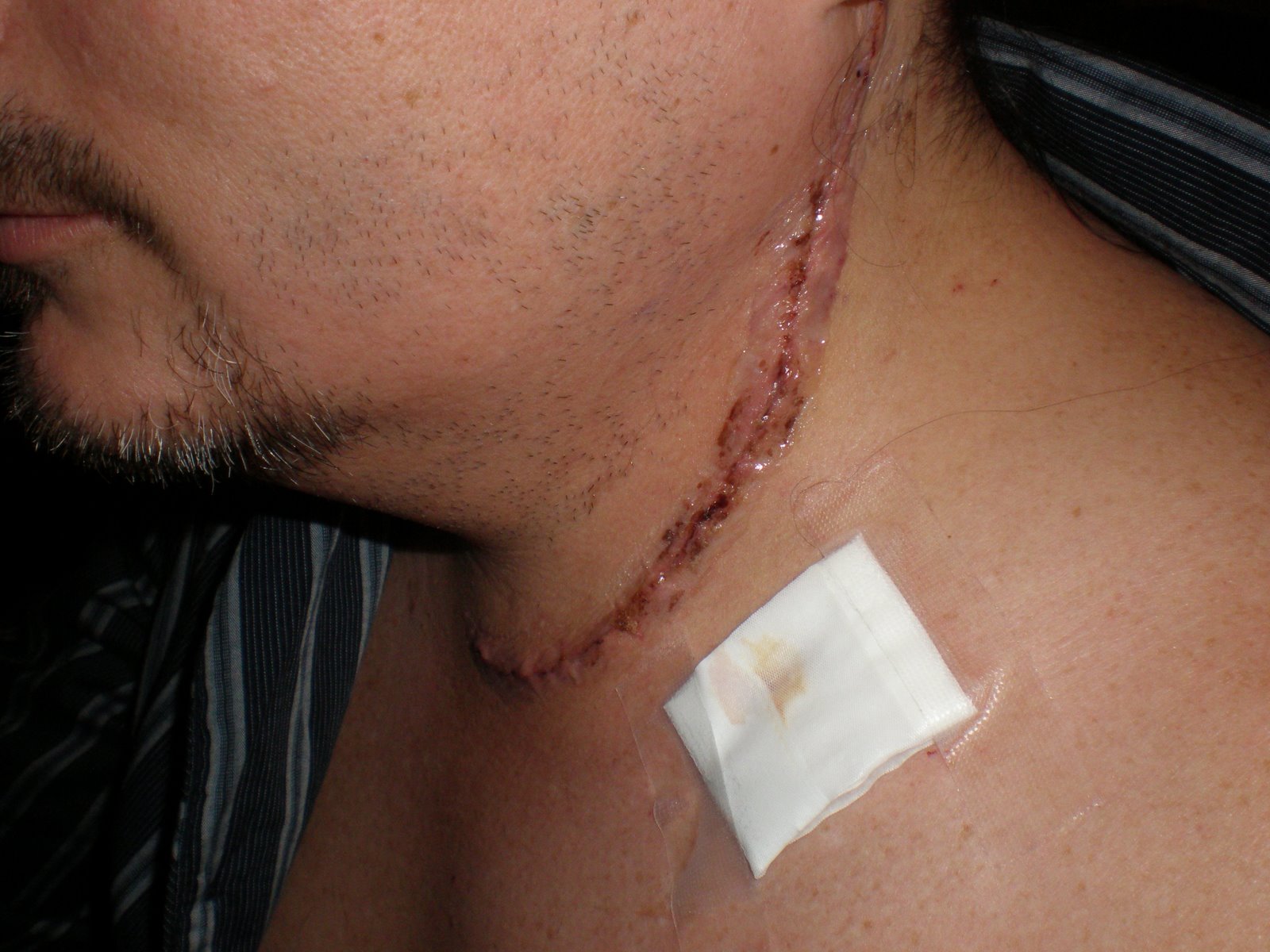
Above is my scar. I’s about 10 inches long and is sexy as hell. The patch is where the drainage tube was that evacuated excess fluid from my neck. It’s gone now, obviously.


Above is the mass removed from my neck. The actual cancer is the knob in the top left. The rest is the lymph structures attached that were removed in case microscopic cancer cells got into the tissue. Way top left (darker mass) is the neck muscle that had to be removed – really a small section.


Above is my neck splayed open after the mass had been removed. You can clearly see my jugular artery and my facial nerves (by the blue paper).

Anyway – I am starting to feel better, but the pain is pretty acute still. Fortunately I should regain nearly full use of my left arm andneck as very little musclewas removed. I am confident that thi is the first step on my road of recovery.

My Own Comic Strip

I stumbled on an awesome site today. It allows you to create your own comic strip online. I have my comic strip/blog set up. Go check it out!

http://binarybiker.stripgenerator.com/

Here’s a sample of what I made! (click to enlarge)


Cancer Surgery Date and Details

My surgery is on Monday the 29th of this month at 12:30pm. It will be performed at Winter Park Memorial Hospital in Winter Park, Florida. The surgery is expected to last between 2.5 – 4 hours. My surgeon is doing the following:

1. Biopsy my voice box
2. Biopsy my tongue
3. Biopsy the back of my throat
4. Remove my tonsils
5. Dissect my neck and remove the cancerous lymph nodes.

I can expect some rehabilitation for my left shoulder after the surgery as a critical arm nerve will have to be moved to get to the cancer. I can also expect a lot of pain and discomfort from the tonsillectomy. Adults fare very poorly with tonsillectomy. The neck will be sore but fairly manageable from a pain perspective. To minimize scarring, it will be stitched on the inside and the outside will be sutured with glue (although I WILL have a sexy cool scar).

I can expect to be in the hospital for 2-4 days, depending on how annoying I am to the nursing staff. Thanks everyone for your supportive and kind words and offers of help. I definitely appreciate it and will continue to update this small list of people on my status; I figure it’s always better to hear it straight from the horse’s mouth than from someone else.