
 February 22, 2009
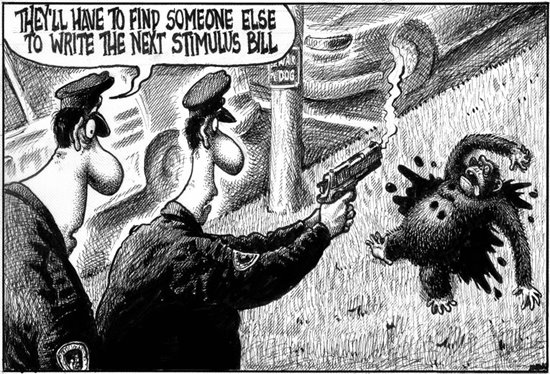
This cartoon, printed in the New York Post by cartoonist Sean Delonas has stirred up a huge controversy, as most of you are already aware. According to many, it is a cartoon that is not just a denouncement of Obama’s stimulus plan, but it is also filled with racial undertones.
In the cartoon, two police officers stand over the bullet-riddled body of a chimpanzee, with one officer stating that we’ll need someone else to pen the next stimulus bill. The cartoon ostensibly refers to the recent story about an out-of-control chimpanzee that was killed by police after it mauled a woman and ties this event into the stimulus package. The meaning is clear – only a crazed chimpanzee would pen this stimulus bill.
It’s not so simple, though. Barack Obama is our first African-American President. Since the stimulus package is his first major Presidential economic initiative it can be argued that the cartoon is calling Obama a chimp – a term that has been used in a derogatory fashion against black people. Many civil rights advocates and just as many publicity hounds have risen up against this cartoon, the cartoonist, and the New York Post as a result.
When I first saw the cartoon I did not immediately see the racial undertones, but having had them pointed out to me I can see them now. They are there – and it’s sad. I am not calling for the termination of the cartoonist as the NAACP is, though. But I am confused a bit.
I remember a few years ago I stumbled upon an article where the NAACP was calling for a boycott of hard drive manufacturers because of terminology used to describe two IDE hard drives connected to the same controller. One is the “master” and one is the “slave.” This master/slave terminology was labeled racist and insulting to African-Americans.
At the time, I had energetic debates with many people about how powerful cultural images are. And I concluded that they are powerful because people make them so. Seems self-evident, right? But it took a lot of thought for me to completely realize how true this is.
Yes – America unfortunately was a slave nation for part of history. We had white masters and we had black slaves. Less known is that the north had pseudo-slavery as well; it was called indentured servitude and it was colorblind. Of course, the option of freedom was there, even if it could rarely be realized.
So – as a result of our sordid national past we have a stigma around the terms “master” and “slave.” Americans, however, don’t own those terms. They have been around for much, much longer than we have been a nation. So to use the term in conjunction with hardware may or may not be offensive – but I could not find a better way to refer to the relationship.
Similarly – chimps and metaphorically referring to ineptitude through chimp comparisons has been around much, much longer than America.
So at what point do stop being so sensitive? Or do we continue to be sensitive and walk on eggshells around any term that vaguely refers to America’s less than glowing past? I am confused.
Let me tell you a story. There was a young man named Sparks who was about 18-years-old. He worked as a manager of a video store in Orlando, Florida. One day, a woman returned a movie to the store, claiming it was damaged and she could not watch it. She was, coincidentally, a black woman.
Sparks gladly replaced the movie for her – she took a different movie, though. Not a new copy of the one that was “broken.” She returned two hours later with the same story. Suspicious, Sparks looked at the tape; it wasn’t even rewound and was at the end. Popping it into a VCR, he saw that it was playing just fine.
Still – the customer is always right, right? So he, again, allowed the customer to get another movie and sent her on her way. You know what happened next?
You guessed it. Two hours later she returned with the same story. The third movie was watched to the end, and it played just fine in the store VCR. Sparks refused to give her another movie.
The lady, with her three-year-old child in tow, got very irate and started raising her voice. Sparks tried to placate her, asked her to calm down and told her that she must have a broken VCR because the tapes worked fine. He never accused her of trying to scam the store.
The lady, once she got angry, was not about to cool down. She got louder and louder, despite Sparks’ best attempts to defuse the situation. Then she started dropping F-Bombs right in the store – which was filled with Saturday families shopping.
So Sparks got a little angry himself and told the lady, “Hey – you need to calm down. This language is not appropriate in the store and if you don’t calm down I’ll have to ask you to leave.”
The lady threatened Sparks – saying she should climb over the counter and beat the shit out of him. To which Sparks responded:
“Thanks for showing me your true colors lady.”
What Sparks meant was that her true self had emerged. She was a bully. An angry customer who used threats of force to get her way.
The lady, being black, took it racially – although Sparks had used the term “showing your true colors” correctly. She reached behind the counter, picked up a metal “inbox” and smacked Sparks in the face with it. His face bleeding from a 2-inch gash in his forehead, Sparks watched in disbelief as the lady scooped up her kid and ran out of the store.
That, my friends, is the best way to describe this situation as I see it. If you’re looking for insult, no matter what someone says, you will find it. When you wear a chip that large on your shoulder someone will eventually knock it off – probably accidentally.
When is sensitivity to racial issues TOO sensitive? At what point can we use appropriate wording and imagery without fear of reprisal? When can a white man say to a black woman “show me your true colors?” and when can a cartoonist pen a cartoon comparing chimps to the authors of the stimulus bill without having to wade through a bog of racial outrage?



 The Binary Biker