
Rear-end collisions with motorcycles are pretty common. Cagers just don’t see us. While I haven’t seen these in action, the idea of increasing visibility by putting lights on my riding jacket and helmet is awesome.
 December 29, 2014
  0 Comments
Rear-end collisions with motorcycles are pretty common. Cagers just don’t see us. While I haven’t seen these in action, the idea of increasing visibility by putting lights on my riding jacket and helmet is awesome.
December 29, 2014 0 Comments
“What do you suggest?” Max asked, looking up from the menu.
The waiter, in a dirty apron, responded in a thick Asian accent, “Special is good today. Sushi boat.”
“I’ll have that,” Max handed the menu back and turned to sister, who had already ordered. “This is my favorite lunch spot, sis. I eat here every week.”
Sarah ran a distasteful sneaker over the greasy floor and frowned, “Sure is filthy.”
“Yeah – but the food is great. This place has been in this very spot for seventy years.”
“It looks it, too,” his sister said, pointing to the adjoining table. A large roach was crawling from under a leftover bowl of rice. It stood still for a moment, antenna waving wildly, then turned back to the rice.
“That’s gross,” said Max, his face reddening in embarrassment. “I’m sorry. I’ve never seen that before. I’ll tell the waiter and get the manager.” He raised his hand to signal attention.
“Wait,” said Sarah, “Look at what it’s doing!”
Max lowered his hand and peered at the table. The roach was pulling out only the brown rice and was seemingly laying them out in a pattern.
“Oh my GOD,” whispered Sarah, “It’s spelling something.” They watched, horrified and fascinated at the same time as the words became clear.
Sarah looked at Max, then the roach, and read the rice words, “MY NAME WAS JIMMY CHIN.”
“Dammit Jimmy!” the waiter yelled and approached the roach, scattering the rice-spelled sentence with a wave of his hand. Both Max and Sarah jumped at the sound and watched as the waiter scooped up the roach one-handed and stuffed it in his apron.
Max searched for his voice and found only a piece of it, “Y-you know that roach?”
The waiter nodded as he placed the sushi boat in front of Max, “Is Jimmy Chin, my great-great grandfather. Very bad karma. He have long time to go before man again.”
Shocked, Max could only look at the waiter. Sarah asked quietly, “How long ago did he die?”
“He die in 1958.”
“er, What,” asked Sarah, “was he before he was a roach then?”
The waiter smiled, showing his jagged, yellow teeth. He rubbed his belly and pointed at Max’s boat, “Before, he was sushi.”
Sarah gasped, “You didn’t eat him did you?”
“No,” said the waiter matter-of-factly.
“Lucky sushi,” Max muttered under his breath, looking at those teeth.
“He did,” the waiter pointed at Max
(c) Ron Sparks
December 28, 2014 0 Comments
It was a Saturday evening,
my wife and I ambled into the bookstore
with steaming hot cups of coffee in our hands.
The warm air breathed sensually across my face
and down my neck, smelling faintly of paper,
glue, and memories of childhood.
It felt good, that warm blanket of air that
wrapped around us as we shook off the
winter chill. I gripped my wife’s hand
in muted joy. She graced me with a Mona Lisa smile;
we separated as she moved with lithe grace
to the mystery novels and I plodded my
way past shoppers to the science-fiction books.
A curious book caught my eye, “The Magician’s Bible.”
I approved of the title; more books needed
the word “bible” in their titles.
With certainty borne of being a bibliophile
I knew that if I wandered around the store I would find
the Cookbook Bible, and the Comic Book Bible,
the Bible of Great Poets and even
The Bible, pick your version.
Bible; a word that, as Inigo Montoya would say,
does not mean what you think it means any
longer –
A word invaded, assaulted,
and besieged by modern connotations.
Chafed and bruised, it’s been used and left
behind as something both less and
something more.
No longer a word of holy origin
No longer spoken of in reverent and
hushed tones.
No longer what it was. Subsumed
and saturated in a broader definition.
And then I looked around the bookstore
filled with the middle-aged and elderly.
Anachronistic and obsolete, they prefer
the printed page, the tactile feel of paper
and not haptic feedback on a backlit
screen.
Apps and Internets and bandwidth –
foreign terms, strange concepts
unimaginable and inexplicably
complex. How they must
fear and resent the surge in
technology, these dinosaurs
in this museum of nostalgia.
Surely they felt a vague unease
as they stared at The Magician’s Bible
clinging to a narrow definition and
unable to comprehend the new and
greater
vision of it.
I pulled my smartphone,
loaded with an entire
binary library on a
miniscule chip,
from my pocket and
pondered
the significance of it.
I frowned as I realized I was
in a cemetery
The warmth was suddenly
oppressive
so I found my wife,
grabbed her elbow,
and led her back into the
winter night
– Ron Sparks 12/28/14
July 21, 2014 0 Comments
I wrote this a number of years ago for publication in a long-forgotten online magazine that is now defunct. Since I have been talking scifaiku on Twitter with some people lately, I thought I’d republish. Enjoy!
Recently, while trying to define and explain “scifaiku” to someone, I was told that he “did not like the sci-fi stuff [and] did not see its purpose in poetry.”
Granted, science fiction poetry is not sweeping the world by storm, but neither is it non-existent. There are thriving Internet message boards, online publications, and print publications that cater to the sci-fi poet. I was, momentarily, at a loss to justify one of the more recent types of sci-fi poetry; the “scifaiku.”
Scifaiku is a style of poetry that stems from the traditional Japanese haiku. Like a haiku, they are short, minimalist poems that deal with tangible sense experiences. Unlike haiku, science fiction topics are integral to their construction. Whereas haiku has been described as dealing with the “natural world,” scifaiku deals with the limits of imagination.
I realized, after a moment’s thought that I was not being asked to justify scifaiku or science fiction poetry in general, but science fiction itself. In order to understand the relevance and appropriateness of science fiction poetry, I had to justify the entire genre of science fiction.
Science fiction plays a very important part in our literature, our culture, and in our lives. It has been around for centuries. “Utopia” by Thomas Moore was written in 1516 A.D. Sir Francis Bacon penned “New Atlantis” in 1628 A.D. One of the first “hard” science fiction stories that combined real science with reasonable speculation was Mary Shelly’s “Frankenstein,” written in 1817 A.D.
Science fiction is, simply, a mirror of the time and place in which it was created. Allow me to explain; sci-fi written in the 1800’s reads completely different than sci-fi of today. Even sci-fi written forty years ago is vastly different than the sci-fi of today. It is different because the society in which it was created is very different than the society of today.
As a result, sci-fi is a reflection of society. One of the most exalted purposes sci-fi serves is to take situations, fears, attitudes, and concepts of the current day and place them in a fantastic setting. In that fantastic setting those problems and concepts become exaggerated, often shamelessly, and easier to recognize. Science fiction allows us to examine key driving forces of our times.
I’ll use a classic media example: Star Trek. The original series, from the 1960’s was a reflection of American society at that time. There was the Federation and the Klingon Empire. They were empires at odds with each other, each with the capability and means to destroy each other. The series celebrated cowboy diplomacy and brute force as a means to win the day. The Federation was Good and the Klingons were Evil. Exploration of the new and unknown was the goal of the starship Enterprise.
It was not at all unlike the society of the 1960’s. America and Russia were entering the Cold War. America was Good and Russia was Evil (if you were American). America was in an unprecedented space race with the Russians. The moon was a national goal; we would reach it in the next decade. We would explore the new and unknown.
Fast forward to the late 1980’s. Star Trek The Next Generation comes out and it is a reflection of American society at that time. The Klingon Empire had fallen and joined the Federation. A new enemy, the Romulans, lurked menacingly behind the Neutral Zone. The new captain of the Enterprise was older and more thoughtful than his predecessor. His mission was not to explore, but to work within the Federation to keep the peace. Diplomacy was always the preferred solution and force was rarely used as a solution.
Similarly, in the late 1980’s, Russia crumbled and the Cold War ended. The Berlin Wall came down in 1989 and, for the first time in decades, families and friends were reunited. China began emerging as a serious power. The moon had been visited – been there, done that. Our exploring days were on hold and domestic concerns were becoming more pressing and more often in the minds of average Americans. America was involved politically with nearly every country on Earth and there were no great wars of the day.
Star Trek was, and still is, a mirror of the society and times in which it was spawned. It’s easy to see with Star Trek just how much a society changes in 20 years; how much our society has changed. Science fiction has to have relevance to the time in which it was written. As a result, science fiction acts in many ways as a reflection of those times and of that society.
Today we have a number of driving forces that are evident in our science fiction. Perhaps the most prevalent is the theme that our technology is outstripping our morality. As technology advances it becomes apparent that no single person can understand, or even recognize, it all. This theme has actually always been present in science fiction. Again, the classic example is Mary Shelly’s “Frankenstein.”
Technology is all around us; cloning, bio-warfare, space telescopes, evolution, alternate power sources, stem cells, and so on. More and more, the common man is unable to understand technology and must take its working on faith. How many of us really understand the process by which electricity is created in a nuclear power plant and sent to our homes? The average person accepts the workings of technology on faith and has little knowledge of how or why it works.
Our society has a very rich Frankenstein complex as a result. There is a general undercurrent and fear that our science is not stopping to think about what it is doing. It’s present in our press and politics as a wave of anti-intellectualism that celebrates ignorance. Our science is running unchecked and is not asking the right questions. Questions like “Should we play God and create clones?”
There is a resurgence of “old world” or “alternate” solutions to problems: Wicca, crystals, natural healing, astrology, metaphysics, and more. Most of our society harbors a belief that science has missed some ancient truths that our ancestors knew and that we can relearn. These are all indicative of our distrust of the technology that surrounds us every day.
Naturally, that distrust is reflected in our literature and in our media. In recent films, it’s seen in such movies as “Terminator,” “Deep Blue Sea,” “The Planet of the Apes,” “The Matrix,” and many more.
In literature, it is of course seen in “Frankenstein.” It is also seen in Terry Brooks’ “Shannara” series. If you recall, in the Shannara series, civilization is built on the ruins of another ancient civilization that was much more advanced. Indications in the books are that the careless and wanton use of technology destroyed that ancient civilization.
The Shannara example is a rather obscure example that I pulled just to highlight the trend of “technological distrust.” There are many more examples that can be found without really even looking. Tolkien immediately comes to mind.
There are, of course, other themes in modern science fiction. Common themes, among others, are “Earth Ravaged By Man,” “The Search for Immortality,” and “Overpopulation.” We live in a complex society with many concerns on our minds every day. Those concerns are integrated and dealt with in our science fiction.
So how does science fiction justify its purpose in poetry? As we’ve already seen, science fiction justifies itself in literature and popular media. It highlights issues of the day in exaggerated settings for appraisal and, hopefully, new and profound insight.
What about poetry, though? And haiku in particular?
One of the main purposes of poetry is to paint a picture that conveys an emotion to the reader. Haiku is the perhaps the ultimate expression of this. Haiku is usually devoid of specific emotive words and abstract concepts but instead simply describes something experienced, in the mind or in reality. It is described with hope that by describing the scene, the reader will experience the same emotion that the writer felt when he witnessed that scene. Haiku usually deals in the senses and in the physical world of, sight, sound, touch, taste, and smell.
Regardless of the style, science fiction still serves the same lofty purpose in poetry as it does in literature and in media. Free verse, sonnet, haiku, senryu, cinquain are all styles of poetry that can, and have, been touched by sci-fi poets. As reflections of the world, the science fiction in poetry may center on an emotion. It may tap into our fear of technology. It may try to give a sense of wonder at our accomplishments. It may create a loathing of war, famine, and prejudice. Science fiction and poetry are merely the venues to express interpretations and reflections of the everyday world around us.
Here is a scifaiku I wrote a year ago, when I was in a field, in the middle of the night, with only my telescope for company:
star-filled night;
nothing moves except
that satellite
This scifaiku attempts to capture the feeling of solitude I felt as well as the wonder of watching a man-made star streak across the sky. It tries to capture that single moment when the night is dead. No breeze, no sound, no motion except a single point of light high above. Looking up at the night sky and seeing something man-made, ISS perhaps, streak across the heavens is a reason to feel proud and humble at the same time.
mature scientist
extrapolates position
the black hole
The above is a haiku death poem in a sci-fi setting. Our society is fixated on death. Religions deal with the afterlife. Science tries to extend life. Poets try to capture our emotions and feelings about death. Symbolically, the black hole is Death and the aging scientist is looking for it – perhaps so that by knowing where it is he can avoid it.
a Hawaiian shirt
pulled tight across his spacesuit —
cheap camera flashes
The above, an older poem of mine, written in traditional 5-7-5 haiku format, is a senryu. A scifi-senryu, if you will. I wrote it when Dennis Tito, the first “space tourist” went to space. The humor is supposed to highlight the incongruity between NASA and the commercial public. NASA would seemingly prefer to leave space for itself and its own pursuits, but the people are speaking. Space is becoming attainable to the average person. This senryu is a reflection of our modern society.
Science fiction has been in our literature for hundreds of years. It serves as a way to examine the driving forces in our society. Science fiction in poetry often does much the same thing; its purpose in poetry is to drive us to feel something, positive or negative, about our society and the direction it is moving in.
If you want to learn more about scifaiku, please visit the Official Scifaiku Website at http://www.scifaiku.com.
July 14, 2014 0 Comments
Just a dump of some of my scifaiku. Some are decent. Some are crap. Enjoy!
climbing trees
a thirteen-year-old
Legolas
01/20/14
microscope eyepiece
reveals a tiny figure
waving at me
07/29/13
ancient fossil
embedded in sediment
wearing bluetooth
07/29/13
inside the pentagram
flickering in candlelight;
hot sauce
07/29/13
fighting ourselves
we never see
— that alien ship
07/25/13
it’s not the video;
she really looks
like that
07/23/13
stuck to my boot –
ferromagnetic
iron oxide
07/22/13
ignorant
the sun is a star
– Americans
07/22/13
living a year
in under two days
– Mercury
07/22/13
that satellite
is wearing a cape!
super moon
07/22/13
i wear a pressure suit –
how did martian dirt
get there?
07/22/13
in the men’s room
peeking under my stall
– tentacles
07/22/13
plastic dinosaur
made from fossil oil –
recursion
07/21/13
just realized
my pets don’t know
my name
07/21/13
stealing my fish
in cold arctic seas –
giant ningen
07/21/13
pixie wings
arachnids donate
their gossamer
07/21/13
that object
large and artificial
blue shifted
07/21/13
signal detected
communicating with
a glass of water
07/21/13
dog-paddling
in zero gee
my beagle
07/21/13
avoid mankind
field trip diverted
schools of thought
07/21/13
vermilion star
glares balefully
upon me
07/21/13
maelstrom pull
across the event horizon
a new universe
7-19-2013
in my helmet
I play reggae
vacuum outside
7-17-2013
she’s pretty
glowing smile and eyes
just bits and bytes
7-17-2013

June 15, 2014 0 Comments
Today marks my second week as a permanent resident of Pittsburgh. I have thrown myself right into the mix of life up here in the ‘Burgh. Last week I ran in the Run or Dye 5k. This week I participated in the 2014 Pittsburgh Gay Pride parade. I’m off to a great start in my new hometown. My wife, daughter, and I were part of the Google contingent in the parade.
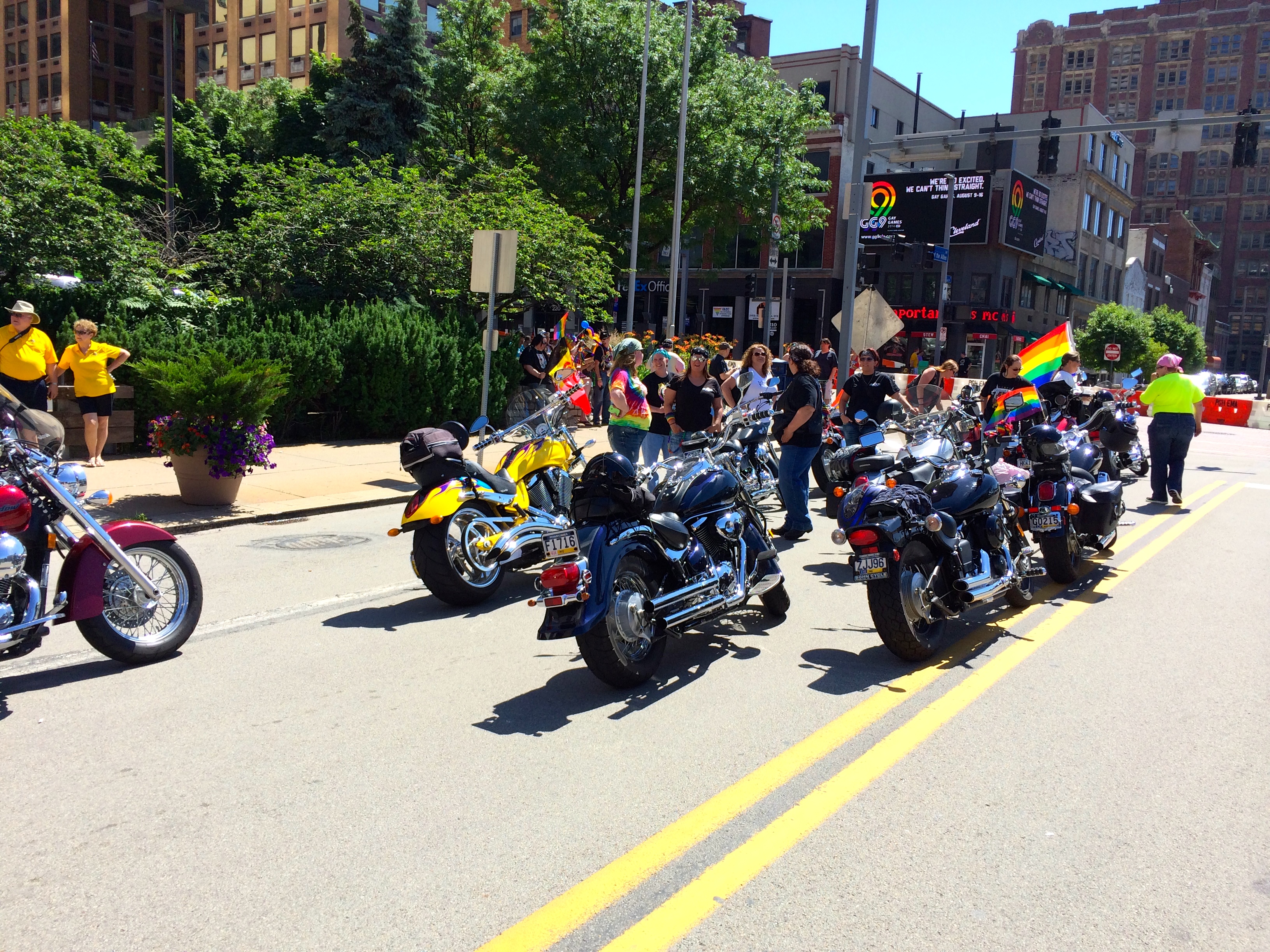
Bombers MC and Dykes on Bikes represented
When I first arrived at the staging area for the parade, I was pleasantly surprised to see that the Google group was situated right next to a motorcycle group. As I was blowing up balloons and bangers, I kept glancing over at the bikers. Many of them were couples, sporting “Dykes on Bikes” vests. But there were others as well. Eventually, I walked up and introduced myself. I’m looking for a good group of people to ride with once I bring my bike up in July. In addition to Dykes on Bikes, there was a number of people from a local motorcycle club called “Bombers MC.” I was quickly pointed to their meetup.com site and invited to join them on future rides. They apparently regularly ride 300+ miles. I am excited; will be nice to have a group of riders up here to hang out with.

Pig Kissing is a Thing?
The group in front of the Googler group was Bottom Dollar Food. Apparently their mascot is a big orange pig. Accordingly, this pig was literally blown up to gigantic proportions and was a crowd favorite in the parade. It took four people to walk the pig.
Our group was lagging behind the rest of the parade because the Bottom Dollar pig kept making pit stops to the bystanders in the parade. The pig’s snout would be lowered and the someone would be encouraged to kiss the snout. The first time I saw it I was pleased, giggled, and made the appropriate “aww” noises along with everyone else. After we were slowed down for the fourth or fifth time for the pig kiss, it started losing the aww factor. In fact, I started wondering exactly how many people had kissed that snout and if the snout was sanitized between each kiss. I don’t think it was. It kind of grossed me out, but at least I didn’t kiss the pig. Still, if a bunch of pig kissers get an unexpected cold, I have a pretty good idea where they got it from.
If you live in Pittsburgh and don’t know about the feud between UPMC and Highmark, you’re probably living under a rock. Pittsburgh is ground-zero in their fight – a fight centered around the fact that UPMC opted to end its hospital and physician contracts with Highmark. I won’t bore anyone with the details or tell you why this should be important to you. I won’t tell you why both are spending millions of dollars lobbying at the state level to advance their agenda and why this affects everyone in Western PA. Google it. However, the Hatfields and the McCoys actually got along for the day. The employees of UPMC and Highmark are just like the rest of us. They are members of the LGBT community and they had a common bond today. It was heartening to see people wearing UPMC support shirts mingling with the Highmark folks and vice versa. Maybe, just maybe, if the corporate executives from both companies could have seen the harmony on the streets today they would work harder on resolving the dispute.
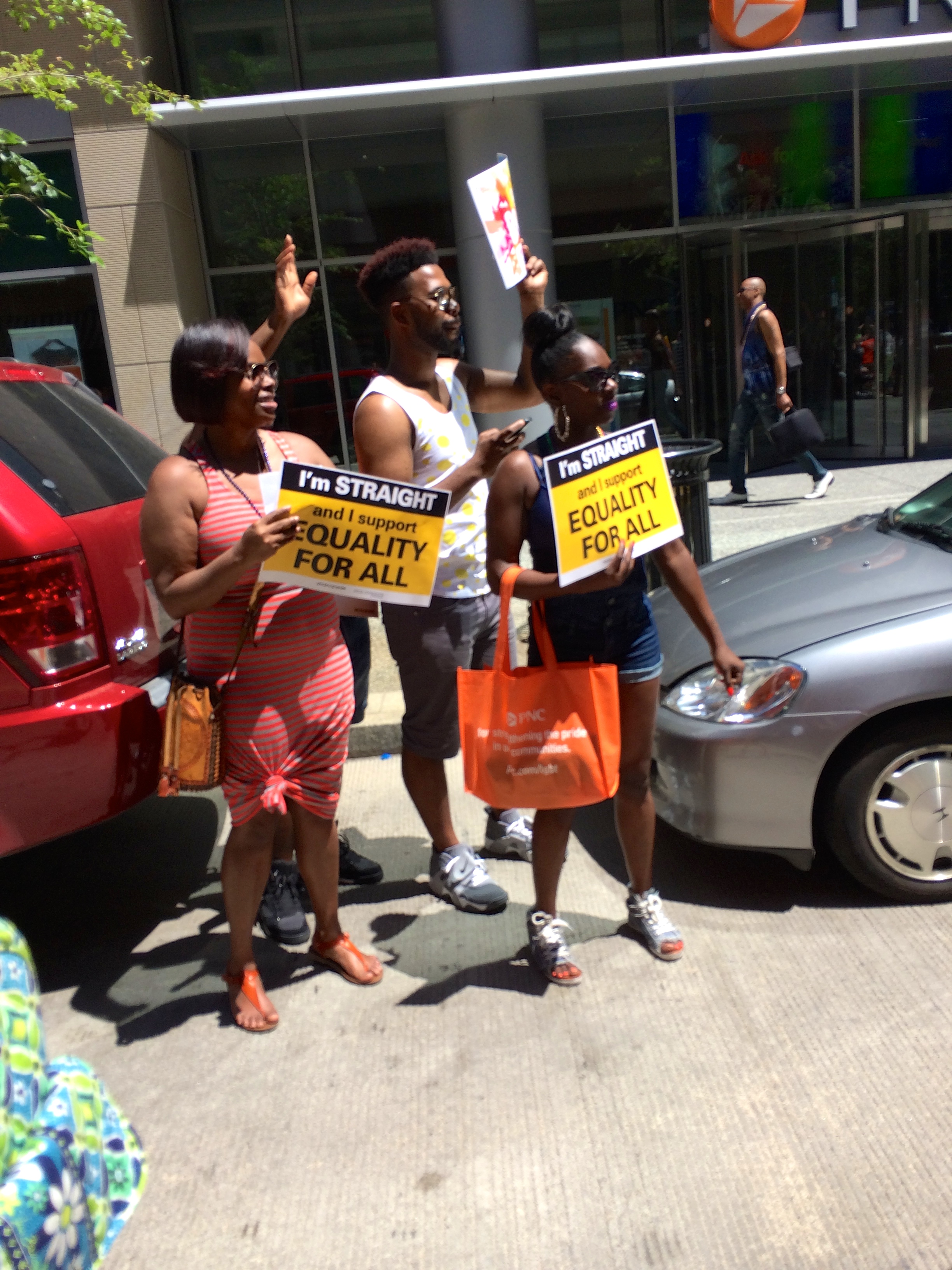
Acceptance and Support was everywhere
This was a gay pride parade, but many, many of the walkers in the parade were straight. They were the mothers and fathers of a gay child. They were the brothers and sisters of a transgender sibling. They were progressives who just felt that equality for LBGT people is important. They showed up in droves, for reasons many and varied, to support the movement.
Support was even stronger on the sidelines. The streets were lined with straight people, gay people, transgender people, young people, old people, and everyone in between. There was an air of joviality and fun. Hands were clapping and people were smiling. Thousands and thousands of people all saying the same thing: it’s OK to be yourself. Sexuality is not a reason to divide us. The love was everywhere and people were not afraid to show it. Acceptance permeated the air. It was refreshing and invigorating for everyone.

Protestors were Present
There were few protestors, but they were present. My daughter asked me, “why do they show up if they know they are so vastly outnumbered?” Having been raised in a strict Southern Baptist household, I know the mentality of religious certainty, dogmatic rejection of the unknown and uncomfortable, and fire-and-brimstone judgmentalism based on the words of goat herders dead thousands of years. I had a lot of answers on the tip of my tongue, but then I remembered when, as a kid, an adult would come to the congregation after a protest.
My answer to my daughter was simple. “They do it for the attention.” It’s not enough for these people to live their life by their rules, they have to try to force the rest of us to live by their rules as well – whether we want to or not. This is what they call righteousness. But at the end of the day, these protestors know that their efforts net, literally, zero gain for them. They crave the “negative” attention at the event and they crave even more the “positive” attention they get when they get back behind the doors of the church and tell everyone how righteous they were, standing in the viper’s den of evil that was the Pittsburgh Gay Pride Parade.

Message Changed by a Smart do-gooder
The protestors were so inconsequential that Pittsburgh’s finest weren’t even near them or attempting to keep them separate from the LGBT friendly crowd. The police and event security were having much more fun watching the stage events and talking to people. There were a total of three pockets of protest; one was at the beginning of the parade route admonishing all of the parade participants and the other two were at the PrideFest shopping, concerts, shows, and events after the parade.
The protestors, with their megaphones and signs of condemnation quickly found that there was no line of protection between them and those upon whom they were casting judgement. Flamboyantly dressed cross-dressers were putting their arms around them. Scantily clad men were parading in front of them, and others were changing their message. The marginalization was so complete that from five feet away you really couldn’t even see the protestors.
And no one crossed a line into violence. It was simply awesome.

What does this mean?
But I liked it. There was a group of people dressed as characters that I did not recognize. I suppose if I were more involved in the LGBT community I would understand it, but it went right over my head. The guy pictured here was dressed as a red angel? Demon? I am not sure. But he was just one of many. There were painted bodies with skull faces. Women wearing horse heads. Other riding hobby horses.
I’m sure a reader of this post will tell me the significance of what I saw, but until then I will appreciate the theatre of it. The time it took to paint their bodies, create their outfits, get ready, and then walk the parade and pridefest dressed in costume was awesome. My virtual hat is off to you.
I think I need to find this dude and get costume tips for Halloween.

Lip-syncing Lady Gaga
I was starting to get crowd weary by this time, so we didn’t stay long, but this performance at one of pridefest was pretty cool. She was lip-syncing Lady Gaga and the crowd loved it. She had all the moves, had the crowd clapping and singing along, and got us all in the mood to party.
Even introverted me, tired, hot, and ready to go home was clapping along and smiling. My daughter was disappointed that we did not stay to enjoy the entire show and now that I am home, I regret not staying for it as well.
All I can say is that when an introvert is done, he is done. It was time to split.

Gay Googlers are called Gayglers
My wife works for Google. Last year she had just started working for the company and did not participate in the parade as a Googler, but this year she did. And brought me and our daughter along.
I learned today that Googlers lovingly call their gay employees Gayglers. Gayglers are proud to be called thus and enjoy a judgement-free, full acceptance environment at the workplace.
Googlers brought their wives, husbands, partners, small children, and friends. We all came together to support not just the Gayglers in the group, but the entire LGBT community.
Google is well-loved in Pittsburgh. When we paraded by the announcer-booth and were introduced as Google to the crowd – the crowd went wild. Far and away the applause and hand-waving from the people watching the parade was longer and louder for Google than it was for the kissing pig in front of us.

I love my wife and daughter and am proud of them.
I can think of no better way to spend Father’s Day than to have been in the Pittsburgh Gay Pride Parade with my wife and daughter. I am heartbroken my sons in Florida were not able to be here with us, in this parade, but they called immediately after and were jealous they couldn’t make it. They wanted to be here to support LGBT equality as well. I am so proud of all of my family.
Every parent needs to accept their child and love them – the sexuality of my kids has nothing to do with how much I love them. I accept them for who they are.
I saw this same sentiment in so many families today. Fathers, mother, brothers sister, cousins, aunt, uncles – healthy and strong families were all present. Some of these families had a member who was gay. Some did not. Some had transgender members. Some were gay couples with kids. Some were gay grandparents with their heterosexual children and grandchildren.
There were lesbian couples dressed as wonder-women pushing their kids around in a stroller. There were lesbian couples cradling a newborn baby. There were gay men swinging a child between their arms. There were heterosexual men and women tying shoes, wiping noses, and chasing their kids.
Families are strong when there is love and understanding between the members of the family. I saw that everywhere today.
The parade route was exactly one mile. I tracked it on my Nike+ watch.
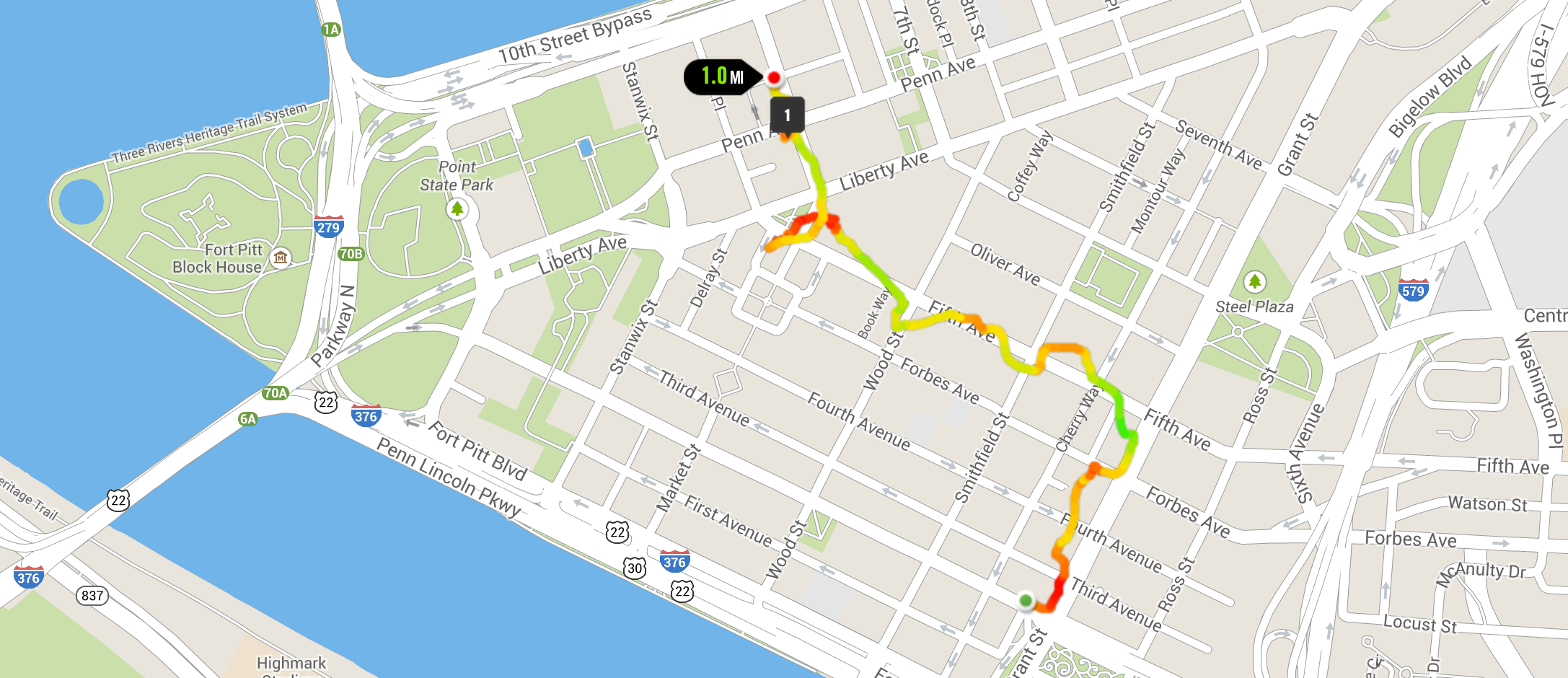
The Parade Route (click for larger)
Here are some other pictures of the parade. Click for larger images. I had a great time and was pleased to learn that Pittsburgh is such a progressive and accepting town. My new hometown made me proud today.













June 7, 2014 1 Comment
Today marks exactly one week since I’ve moved to Pittsburgh, PA. About a month before I moved up here, the Binary Princess committed me to a 5k race, the Run or Dye 5k. She’s been wanting to do a color run for a long time and was so excited this finally came to Pittsburgh.
So we hiked our way about an hour outside of Pittsburgh to Butler County and made our way to the race ground, Camp Lutherlyn – a country, religious, activity and campground. The ride out was beautiful and we (the Binary Princess, myself, and our daughter) were looking forward to a great run. Once we got parked, we quickly made our way to registration and picked up our race kits.
We had a great run, the weather was perfect, but the course wasn’t a true 5k! I was wearing my Nike+ watch and our distance was only 2.4 miles so it was a quick run, but a little disappointing.

Our 5k was a little short!
It was a trail run, and parts of the run were extremely muddy, but we didn’t mind because we were having too much fun. The race was over before we knew it and then we participated in the after-race festivities, most notably the dye bomb you see pictured above. That’s when the trouble began.
Poor planning, a single one-lane road, and ten thousand people made it impossible to leave the race afterwards. It, literally, took two hours after the race for traffic to get to the point where we could leave.
Run 5k in 30 minutes, sit in car trying to leave for 90 (and counting) #runordye #pittsburgh #fail
— Ron Sparks (@ronsparks) June 7, 2014
We did eventually get out of Camp Lutherlyn. I will run the race again if I get the chance, but only if they pick a venue we can actually get out of or if they better manage parking. Below are some pictures of the event.



May 9, 2014 1 Comment
The time has come for me to join my wife in Pittsburgh. A year ago, I blogged that my wife was moving to Pittsburgh because she got a job with Google. We made the difficult decision that I would stay in Florida for two reasons:
I fully intended to stay in Florida until my son graduated high school and my company had cashed me out in a big way, but it just didn’t work out that way. A change in mindset and a fortuitous event set the stage such that it became evident that the time to move was now. It’s funny how that works out sometimes.
I resigned from my job a week and a half ago. For the past few months, it has been harder and harder to stay focused while I missed my wife. The constant traveling, living on Skype, and being – lonely – all the time was taking a toll on me mentally. My performance suffered at work and my personal relationships were strained as I became more and more of a recluse.
I would rush home the second I got off work to fire up Skype so I could spend time with my wife. I would cancel outings with my friends and structure my entire life around having to be home every day just so I could Skype my wife for a few short minutes. The more I longed for my wife, the less time I spent with my friends, furthering my isolation and loneliness. Already an introvert, I became even more withdrawn.
If you look at my blog posts, you’ll see that I stopped writing. I stopped doing the things I love – the things that define me – because I was lonely. I rode to Biketoberfest and Daytona Bike Week and Sturgis, SD this past year – alone. It was a terrible feeling to go to a bike rally without the woman who makes it all enjoyable for me. So I stopped riding as much. I gave up so much of myself because I was lonely.
It was becoming a terrible burden and was impacting every area of my life. I realized that the situation was becoming untenable. A change was going to have to be made. My wife couldn’t leave her job – she’s doing an awesome job at Google and I am so proud of her. As much as I enjoyed working for a small startup with vision and drive, I realized that I needed to go up to her, not the other way around.
Still, I didn’t pull the trigger. I hoped that things would get better. I started forcing myself to hang out with my friends. I threw myself into working out so much that I was doing 500-600 push ups a day, running/walking 2.0-5.0 miles a day (not a lot for most, but it was a lot for me), and doing VO2 max training 3 days a week. And I blew my shoulder out.
I had great days at work where I had vision and clarity, and then I had days where I couldn’t focus because all I could think about was my wife. It was almost bi-polar. Some days I could focus and be “on” and others I was just “off” and nothing could get me right again.
And then my son decided he didn’t want to be in a physical school next year. He wanted to be in virtual school – taking online classes.
That changed everything. In virtual school, he has no restrictions on where he has to be to attend school. He can spend literally a month or more at a time with me in Pittsburgh and still attend school in Florida. I would no longer have to sacrifice my time with him to be in Pittsburgh. It would be a change, yes, but something we could manage.
So I resigned. I am unemployed and not looking for a job until I get to Pittsburgh next month. I am spending the remainder of May packing up and getting out of the Florida house and spending quality time with friends and family before I get up to Pennsylvania.
I have a lot to do, but I am excited for this next chapter of my life – especially now that I have a plan to make sure I don’t lose any time with my son. I’m also looking forward to the great rides up north on the motorcycle – but I am not looking forward to the six months of unrideable weather.
Wish me luck, readers!
(oh – and since I made the decision to be up with my wife in Pittsburgh, I have written well over 20,000 words)

January 23, 2014 0 Comments
obscured by my breath
rocket rising in the east
I forget I’m cold
© Ron Sparks
Watched the NASA TDLR-L Atlas 5 rocket launch this evening. The picture above was taken from my neighborhood on my iPhone over 50 miles from the launch. Awesome.
January 22, 2014 0 Comments
my dogs fidget,
bitter draft under the door –
outside, the storm howls
© Ron Sparks
 The Binary Biker