2004 Kawasaki Vulcan 1500 Classic

Binary’s New Ride!

Yes – the Binary Biker finally has a new ride. Just in time for Daytona Bike Week 2012!

My old ride, the 1992 Honda Nighthawk CB750 has served me well.  It has seen me through the toughest phases of my life, but she was a small bike and after my ride to Kentucky and back, I realized I needed a bigger bike for the long rides I planned to take.  The itch to get a new bike has been under my skin for months now, but it was an itch I was reluctant to scratch.  I couldn’t make up my mind on what I wanted and, honestly, I was not comfortable dropping a lot of coin on a bike right now.  I’ve got a new job, a son about to start college, and I need to get a new house soon – it would be irresponsible to spend money on a brand new ride.

I have a buddy named Eric; we’ve known each other for nearly a decade, and have ridden many times together.  His ride was a 2004 Kawasaki Vulcan Classic 1500.  Over the years, with the birth of his daughter and other shifting priorities, he has stopped riding.  I’ve known this for a long time and have been politely reminding him every few months that if he ever wanted to sell his bike, I would be more than happy to consider buying the bike.

Apparently I finally wore him down.  Last week he named a price and told me he was looking to sell his bike.  He wanted to reclaim garage space and the bike had sat idle for the better part of a year with only the occasional firing up.  I looked for a stick to beat the price with, couldn’t find one, and readily agreed to his terms.

Turning the Nighthawk into a Bobber

Turning the Nighthawk into a Bobber

I made a deal with good friend Brock to buy the Nighthawk.  He’s going to work with his daughter to turn it into a sweet Bobber, like the one pictured here.  Yes, that bike you see is  Honda Nighthawk.  He’s got big plans for the Nighthawk and I can’t wait to see how she turns out when he is done.

In fact, he has mentioned that he may be willing sell me back the Nighthawk when he is done, because he really just wants to mod the bike, not keep it forever.

I’m seriously considering that.  If the Nighthawk could be made into what you see to the left, I would definitely be interested in getting her back.

Rolling 20,000 miles on the Nighthawk!

Rolling 20,000 miles on the Nighthawk!

Before I could sell the Nighthawk to Brock, though, I had to achieve one last milestone on her.  A few years ago, at the very beginning of some major personal issues in my life, I rolled 10,000 miles on the Nighthawk with my other really good friend, Big Bad John.  I have always, in my mind, associated that milestone with some negative images in my life.  I had to roll 20,000 miles before I sold her.  I took the Nighthawk out earlier in the week and rode her until I hit the magical milestone, and I sighed in relief.  This milestone marks one of the best times in my life, not the worst like the last milestone.    It’s a purely symbolic gesture, but it means a lot to me to have done it.

Milestone achieved, I sold the bike to Brock and financed my purchase of the Vulcan from Eric.  Win/win for everyone!  The Vulcan is a great bike.  She’s a 2004 with 15k miles on her, custom Vance&Hines pipes that are LOUD, and a great classic look and styling.  She rides great, looks great, and is just all-around cool.

That's a dirt carb part!

That’s a dirt carb part!

Because she had sat so long, the carbs were all gummed up.  I rode her over to Brock’s house, because he has a garage, and we stripped her down and cleaned the carbs.  It was a dirty process and I was surprised when we got her stripped down how small the carbs were compared with the size of the bike.  I’m going to have to upgrade sometime for more power I suspect.

The carbs were pretty dirty and took a while to clean.  We left out a piece when we put her back together again, so she was running rich, stalling, and blowing black smoke and flames from the pipes.   We found the missing part and got her back together again.

Honestly, Brock did all the work and I held screws and lights.  I’m not very adept at bike mechanics, which is why I always take my bike to the shop.  Brock, however, has taken apart hundreds of carbs and this was right up his alley.  Now the Vulcan rides like a dream, sounds great, and is just about ready for Daytona Bike Week 2012.

Now all we have left to do is change the oil, plugs, and shine her up for Bike Week.

Carey has already told me that she wants a sissy bar on the back for when she rides.  I will try to look for one this weekend at Bike Week.  I am very excited to own this bike.  I have been planning for years to meet my best friend Ron at Sturgis on year – now I finally have a bike that can make the trip!

My 2004 Vulcan Classic 1500

My 2004 Vulcan Classic 1500

Ronald C Sparks

Rest in Peace, Grandpa

Ronald C. Sparks was my grandfather. He passed away last Thursday.  Born in Portsmouth, Ohio on October 14, 1925, he was 86-years-old.  These are the words I wrote, and spoke, today at his funeral service.  I worked on this with my brother and sister, and I am honored to have given his eulogy.  My sister and I also wrote his obituary, and you can read it here.

I called him grandpa

He was one of the most influential people in my life. That’s not a claim I make lightly. If you think about it, we all know hundreds of people. We meet thousands of people every year. Some are people you bump into at the grocery store and never see again. Some become fast friends. Some are family. If you’re on Facebook you probably even have friends you’ve never met. It’s safe to say that I have met tens of thousands of people in my lifetime and my grandpa tops the list of people who have molded me into the man I am today. I’d like to spend a few moments talking about my grandpa – giving you a glimpse of how I saw him.

Each of you knows my grandpa. Many of you know him in ways I can never know or understand. If I’m lucky, some of you will share your stories about grandpa with me this afternoon.

So where do I start? My earliest memories are on my grandparents farm in Southern Indiana. My memories of that time were when I was just a child much younger than my three teenaged children here today. Grandpa’s great-grandchildren.

Learning to Shoot a Rifle

I could tell you about how grandpa taught me how to fire a rifle. On that farm we had two barns. We had one that was the “regular barn” and we had one we called the Tobacco barn. Between the two were one of the fields where we planted crops. Sometimes nuisance groundhogs would plague the field and threaten the crop.

Before I continue let me tell you about the Tobacco barn. The tobacco barn was a mess. It was dilapidated, dingy, and falling apart. Grandpa warned me several times to never go into the Tobacco barn. It was dangerous. I believed him. I never thought to question or doubt. It was a scary barn, just to look at.

I don’t like to be a tattletale, but I just found out yesterday, though, that my sister Rhonda regularly disobeyed the command to steer clear of the tobacco barn and went climbing through it all the time.

So anyway, between the tobacco barn and the regular barn were fields where we planted crops and groundhogs were a nuisance. They could dig holes so deep that a tractor would literally tip over if it hit the hole. Shooting the groundhogs was a necessity – for safety reasons and to save the crop.

I remember my grandfather handing me the rifle. He spent time showing me how to operate the gun, the safety rules of handling the gun, how to aim, and how to slowly pull, not jerk, the trigger. I grabbed the rifle from grandpa, sighted down the barrel, and I fired that rifle downfield at the groundhogs. I missed, of course, and the recoil from the rifle knocked me backwards and hurt my shoulder. The sound of the shot being fired startled and scared me. Grandpa chuckled, and handed the rifle back to me, even though I was suddenly afraid of it. Because that’s what he did; he taught without teaching. He led by example. He knew I was afraid, but he just handed the rifle back to me and let me make the choice to try again.

Grandpa taught me my love and respect for firearms. And he also passed it on to my children. A few weeks before this last Christmas, I took grandpa and my oldest son Matthew to the gun range. At 86 years of age, shooting from a partially blind eye, grandpa managed to hit his target every single time with a spread no larger than my hand.

Iced Tea

1945 – Ronald and Hershel Sparks

1945 – Ronald and Hershel Sparks

One of my favorite stories about my grandpa is the story about iced tea. Every day, for 45 years, grandma would serve grandpa a glass of iced tea with dinner. Every day, without ever saying a word, grandpa would drink that glass of iced tea.

One day, though, after 45 years, he asked my grandmother why she always served him iced tea. Her reply? “Because you like it.” He told her he had never liked iced tea. For 45 years, without complaint, he drank what his wife provided him. A child of the depression, grandpa learned to be thankful for what he had.

I think about that a lot. About how spoiled I am. I have never wanted for anything. I have never been hungry. If my waitress at the restaurant brings me the wrong drink I get offended and send it back with much todo. And my grandpa never complained about being served a beverage he didn’t like. For 45 years. I don’t know anyone else like that.

License to Drive

Grandpa taught me how to drive. He taught my sister and brother, Rhonda and Russell, as well. His exact words were he “wanted to make sure we did it right.” He spent decades behind the wheel of a truck and cars and the road were a major defining part of his life. He owned dozens of cars throughout the years. I think he bought new cars more often than he bought new pants.

When I was 16-years-old he spent a week looking for, and finally paying for half, of my first car. A lime green 1974 Mercury Comet. He taught me how to change the oil, tune it up, change the tires, and keep it road-worthy. Most of his lessons stuck, but I did have one incident.

I had been driving only a couple of months when my friend and I decided to drive to Cocoa Beach. You all know the route, SR 50 to 520 and all the way to the beach. This was before 520 was widened and it was a 2-lane road all the way to the beach. On the way back from the beach, I got a flat tire.

I wasn’t worried. My grandpa had taught me how to change a tire and I had not one, not two, but three spare tires in the car. I couldn’t tell you why I had that many spares. I just did. I jacked the car up, changed the tire, and we were on our way home in less than ten minutes.

We got a mile down the road when the same tire went flat again. So I changed the tire again. And got a mile down the road when the same tire went flat again. I was down to my last spare.

I knew something was wrong but I didn’t know what. I put the last spare on, crossed my fingers, and started for home again. And got another flat tire.

This was way before cell phones, so my buddy and I had to hitchhike to a station and call his mom to come get us. Grandpa had taught me how to change a tire, but he didn’t think he needed to explain the obvious to me. Keep the tire valve on the outside when you change the tire.

When I told him what I had done – much later I might add – he just shook his head, called me a fool, and walked away.

1970′s – Ronald and Hershel Sparks

1970′s – Ronald and Hershel Sparks

The Bad Guys

Grandpa’s years behind the wheel of a truck gave him the strongest forearms of anyone I have ever met. He was driving for years before these trucks were equipped with power steering. He fought the truck every day, and won.

I didn’t understand as a child where that strength came from, I only knew that he was just about the strongest man I could imagine.

He played a game with us grandkids. He called it “the bag guys.” He would trap our wrists between two fingers and squeeze. Using only a fraction of the strength in his hands and arms, he would send me and my brother to the floor, writhing in pain and begging for release. And we always went back for more.

The worst, though, was when he sat next to me in church. When no one was looking he would get me with the bad guys and squeeze once, quickly, and let go. The sudden shock and pain always caused me to jump straight up like I’d sat on a pin and cry out.

Of course, I always got in trouble for disturbing church. And he sat there, never said a word, and winked at me when no one else was looking.

Just a few short weeks ago he got me in the bad guys again. At 86 years of age, they still hurt.

Grandpa and his Stories

Grandpa had a story for everything. I think he was perhaps the most interesting man in the world. He only recently started sharing some of his stories from the War, and we were all shocked and amazed by what he had to say. Everything from his trip by boat to and from Europe to his wounding, subsequent capture and status as a POW, and his liberation and return home. Stories about how the allies strafed the train he was on taking him to the prison camp, not knowing that it was filled with American POWs. Stories about how he was forced to dig his own grave in Stalag 9b when a prisoner killed a guard for a scrap of food. How he somehow kept on his person through the entire ordeal was a small New Testament given to him before he left for war.

Those stories horrify us even now, more than half a century later. The things he saw. The things he endured. Unimaginable to those of us from softer times.

My favorite stories, though, are his stories about being on the road. He could, literally, regale you with hours of stories from being on the road.

One of my favorites of all time, of the hundreds he told, was the story regarding the truck stop with outhouses instead of modern plumbing. This was in the early 1950s, I believe. The guys at the truck stop had run a speaker from the diner into the outhouse – into the, ahhh, toilet part of the outhouse. They would wait for ladies to enter the outhouse, give them time to start their business, and then turn on the microphone and holler through the speaker, “HEY LADY! WE’RE WORKING DOWN HERE!” Grandpa couldn’t tell the story without chuckling and describing how the ladies would run out of the outhouse in a complete panic.

January 2010 – Ronald and Hershel Sparks

January 2010 – Ronald and Hershel Sparks

Grandpa and His Love for Grandma

Grandpa loved grandma. He was so proud to have her at his side. Recently, one of his favorite stories was how, just a couple of years ago, the regulars at McDonalds were flirting with grandma. He thought she was so beautiful. You could always see it in how he looked at her. Through the good times, the bad and everything in between, his love for her, his dedication, responsibility, and commitment never wavered.

Grandma and grandpa had a love that lasted over 67 years. It might surprise some of you to know that they had met, fell in love, and eloped in a span of time only a few weeks before he shipped out to war.

As his health began to deteriorate he stressed to my father, me, and my sister and brother that we had to take care of grandma when he was gone. He would tell me “don’t worry about me; you just make sure your grandma is ok.” His greatest treasure was my grandma.

Being a Great-Great-Grandpa

Grandpa lived to see five generations spawned from the love him and grandma shared. He was very proud of this, and he loved and adored little Savannah. Savannah would sit in front of grandpa on the living room floor, babbling at him for hours. And he would look at her, nod, and say, over and over again in response to her, “I know.” “I know.” “I know.”

And Savannah’s first sentence was “I know.”

And apparently she does know. From what I hear, you can’t tell her anything. She knows it all – her great-great-grandpa told her so.

My grandfather, Ronald C. Sparks, getting the Purple Heart during WWII

My grandfather, Ronald C. Sparks, getting the Purple Heart during WWII

The witticism of Grandpa

Grandpa always had something snappy to say. Over the years some of his more colorful quips have become almost institutionalized in the family.

He would often jest with my grandmother when they had a minor disagreement. He would glare at her and say “woman, don’t make me mad.” I liked that so much that I use it now, in jest, with my wife Carey all the time.

The last few years grandpa has been fond of saying, when asked how he was feeling, “I could run down a rabbit, if I shoot it first.”

He would often look at grandma and jest, saying either “I’m gonna trade her in for a younger model,” or “that’s the last time I go out with an older woman.” Grandma is only a month older than him.

When imparting wisdom to me, he would stress often, “never bring a knife to a gunfight.”

And of course, one of my favorites was how he constantly teased my, my siblings, and his great grandkids, calling is “rotten kids” every time he saw us.

Conclusion

I miss my grandpa. He was a great man. An American hero, a dedicated husband, an honest man. He was hard, but fair. I loved him deeply, as I know all of you did.  He is my role model and I will continue to walk in his footsteps and, if Im lucky, I’ll be half the man he was.

Grandpa and me at my wedding on October 11, 2009

Grandpa and me at my wedding on October 11, 2009

The Language of CI

The Language of myList

Every office has a couple of phrases that get used, and overused, to sum up or simply express complex concepts.  These sayings become so seeped in meaning that by simply uttering the phrase, an entire host of meaning, context, and understanding is imparted to the audience.  Very similar to an acronym, these pithy sayings reduce a lengthy structure to a meaningful, and simpler, form.

Outside of military acronyms I was exposed to at Hooah, I have never worked at a place with more contextual phrases than here at myList.  New employees are often caught completely flat-footed when these phrases are bandied about in meetings.  They are lost as to the relevance of the saying while the rest of the room nods their heads sagely in understanding.   I wanted to take a few moments to introduce you to some of the most prevalent phrases here at myList.  Some of them you might recognize – others will probably baffle you.

Motherhood and Apple Pie

Motherhood and Apple Pie

Motherhood and Apple Pie

This phrase is used most often by the company’s CTO, Rob, when he’s discussing the vision and scope of our services and applications.

Used to express the perfect, ideal, often unachievable, state of things.  Things are “motherhood and apple pie” when Nirvana is reached, when all things work exactly as planned, or when serendipitous events transpire favorably.  A perfect example might be: “Every user of our application will love the interface and will tell their friends and we’ll dominate the space if  it’s all motherhood and apple pie.”

If it’s all motherhood and apple pie, this blog will go viral and I’ll get picked up by a major aggregator.

Falling on your Sword

Fall on your Sword

Fall on your Sword

This is a phrase most of us recognize.  The meaning is as unpleasant as it sounds, but it does have a noble connotation to is as well.  You fall on your sword when you publicly accept responsibility for a failure.  It’s used in meetings quite often in a context like this, “The deployment failed.  I’ll fall on my sword; it probably would have gone better had I documented the steps more clearly.”

There is, as I stated above, a noble context to it as well.  A leader often falls on his sword to sacrifice himself so his team does not suffer ill consequences.  Success, as they say, has many fathers – but failure is an orphan.   An example of a leader falling on his sword to protect his team might be something like this:  “When the project failed and reviews were right around the corner, Bob fell on his sword for the team.”

Whistle by the Graveyard

Whistle by the Graveyard

Whistle by the Graveyard

This is one of my favorite phrases.  It’s so completely appropriate for the context in which it is used.  This phrase is used when you are agreeing to intentionally ignore a potential issue that might come back to haunt you later.  Just as in real life, walking past a graveyard makes people nervous because of sometimes real and sometimes irrational fears of death, whistling past the graveyard in a business context means something scary is being ignored in the hopes it won’t affect you.

You’ll hear it all the time in a context like this, “Error logging isn’t perfect, but we’re going to whistle past the graveyard on this for now.”   The verbose translation of this is, “We realize the code doesn’t log the error correctly, but we’re betting there won’t be that many errors and we can address it later.  I sure hope this decision doesn’t come back to bite me.  ”

Pigs and Chickens

Pigs and Chickens

Pigs and Chickens

This is my new favorite by far.  The full saying is that “Chickens are involved in breakfast, but pigs are committed.”  We adopted this when we started using Scrum as our software development methodology.  What this means is that a chicken is involved, but not critically, in creating breakfast.  It lays an egg and moves on.  A pig, on the other hand, is completely committed, because his life is on the line to provide breakfast.

What happens at myList, in meetings, is that we have attendees who have an opinion but are not really “committed” to the project in scope of the others in the meeting.  They are the chickens.  The attendees who are on the line in the meeting are the pigs.  For instance, in a development meeting on technology choices, I am a chicken.  As Program Manager I have an opinion, but since my job is not to deliver the code (just the result), manage the code, or architect the solution, I am not as committed as the developers on the hook for sound code choices.  They are the pigs.

You might be a chicken in one meeting and a pig in another, based on the context of the meeting.  It’s completely normal to hear in a meeting, “OK, now that the chickens have left, we can make the decisions we need to make.”  or, “Since we’re the pigs here, we really need to focus on the deliverable.”

Buckaroo

Buckaroo Bonzai

Buckaroo Bonzai

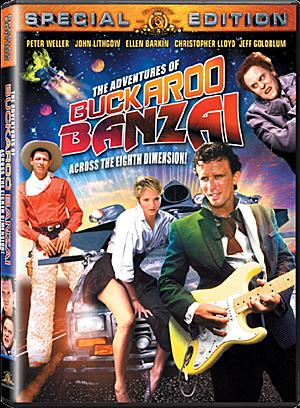
A favorite of our CEO, buckaroo has its roots in the 1984 movie The Adventures of Buckaroo Banzai Across the 8th Dimension.  There is a quote from the movie that drives the entire concept of buckaroo:

“…remember, no matter where you go, there you are.”

This has been interpreted to mean that it must work the same for everyone, no matter what, in every circumstance.  The classic example our CEO uses, based off of his days at Microsoft, is that buckaroo was broken when Microsoft expected business users to use MS Word and home users to use MS Works.  Why would a user who uses Word at work want to use anything different at home?

So, in our design meetings it is extremely common to  hear, “We have to honor buckaroo – if it works for user class A it has to behave exactly same for user class B.”

I Don’t have a Dog in that Fight

I don't have a dog in that fight

I don’t have a dog in that fight

A timeless classic at myList that is a favorite of our CTO.  This is meant to say that you don’t have a vested interest or opinion on the matter at hand – but you’re going to go ahead and comment anyway.  It qualifies your position as being either an impartial observer, not an expert, or not really caring either way.  It’s pretty common to hear it in meetings with many roles present.

When you have developers, program managers, product managers, designers, business analysts, and executive management in the same meeting – people like to preface what they say with the position they are trying to take.  You might hear something like, “I don’t have a dog in that fight.  I don’t care what servers you pick, as long as they stay up 100% of the time.”  It means, I am not taking any responsibility for your choice of servers, and I am letting you know that no matter what you pick, they have to meet my uptime requirements.”

I’m just reporting the news

Report the News

Report the News

This is one of the most used phrases here.  Essentially it says you are a reporter, reporting the news with no bias or opinion.  It’s often used to express an honest “state of the union” of an uncomfortable or unfavorable project.  A person who reports the news is saying they are not trying to color the facts, sugar coat the situation, or misrepresent anything.  The assumption is that a reporter is not trying to steer a decision or opinion one way or another.  A reporter is not casting judgment, and is begging you to have an objective and not have an emotional response to what he is saying.

You might hear, walking down the hallway, “The deployment process doesn’t account for downtime more than 15 minutes and as a result our last four deployments have failed.  I’m just reporting the news.”

It sometimes seems to me that it’s can be use for evil – to express and opinion and at the same time distance yourself from that opinion, but it is rarely done.  “Damn you’re ugly.  I’m just reporting the news.”

Punt on That

Punt

Punt

Another oft-used phrase at myList that has such ubiquitous adoption we aren’t sure where it originated.  Like a punt in football, used in this context it means we aren’t trying to score a touchdown.  We’ll be content with a little victory or with not driving towards the goal – for now.  It’s used to let everyone know that you’re not ignoring something – you’re just not dealing with it at this time.  A punt only gets you a few points but, used correctly, can help you win the game.  It is a strategic decision that a greater scoring opportunity will present itself as long as you don’t focus on a short-term victory right now.  “I know the product needs to be dressed properly, but we’re going to punt on that for now and focus on the path TO the product first.”

Hang an Elephant By a Daisy Off Its Tail over a Cliff

Is it even possible?

Is it even possible?

This one is really, really esoteric.  And it’s lengthy – so it isn’t used often, but I had to throw in here for the novelty effect it has.  It’s a colorful way of saying, “that isn’t possible.”   It stems from the 1991 movie JFK where Kevin Costner claims that science can prove that it’s possible to hang an elephant over a cliff  with its tail tied to a daisy.   It’s used usually in reference to inflated promises of vaporware from vendors or in reference to grand plans that can never, ever, come to fruition.  “The vendor said the product can log inside our network   And then he hung an elephant by a daisy off it’s tail.”

So that’s the short list.  We have a lot more colorful phrases and saying we use here, but this is what I compiled in a quick minute.  I encourage my friends, readers, and co-workers to comment and add the ones that I missed!

Main Street, retro-style

Daytona Biketoberfest 2011

The weekend is over and the results are in: Biketoberfest 2011 was a success.  4 our of 5 drunk bikers agree.  I rode to Daytona on Saturday with my lovely wife, Carey, and my very, very good friend John.  On Sunday I rode by myself and met up with another good friend, Jaime, and his posse.

My quick thoughts before I share the pictures and videos ….

  1. The weather was gorgeous.  The weekend was perfect.
  2. The crowd size seemed a little smaller than I remember.
  3. The beer was more expensive than last year.
  4. I still had a blast.
Here are the videos:
Here are the pics:

How Advanced is Binarybiker.com?

Google has a feature that allows you to show the reading level of a website as a filter in advanced search results.  There are three categories, Basic, Intermediate, and Advanced.  You can use it to rate the overall level of material on any given site.  This is a quick way to see what the reading level of a website might be like.  Here are the results for BinaryBiker.com:

BinaryBiker.com Reading Level

BinaryBiker.com Reading Level

As you can see, my blog is a mixture of basic reading that anyone can read and understand on the Internet and advanced, specialized, information relevant and understandable to a relatively small group of people.  I find this very appropriate – I blog about such a myriad of topics, across a wide range of my interests, that I can find no fault with this rating.  Here’s how some other sites stack up:

MySpace.com

MySpace.com

FoxNews.com

FoxNews.com

NPR.org

NPR.org

BarackObama.com

BarackObama.com

I think I just found myself a new toy. This is going to be a ton of fun this election year.

Tipping is Optional

I was at a restaurant with four co-workers the other day.  It’s one of Orlando medium-to-upscale steak houses, called Hillstone.  The company picked up the tab and I put it on the corporate credit card.  The total was $141.00 for all of us.  Since I always tip at 20%, the tip would have been around $28.00.

Lo and behold, when the check was brought out to me, they had included the gratuity for me!  The restaurant added an 18% tip to the total and asked me to pay $165.00.

I didn’t argue.  I paid the bill, but inside I was fuming.  I have blogged about this before (in a past life on another blog) and my feelings have not changed.

Tipping is optional.  When you add it for me without my consent it becomes a service charge.  Service charges need to be disclosed up front.

My bill - click for larger image

My bill - click for larger image

So Hillstone lost $5.00 in tips because I always tip 20%, not 18%.  But the fact of the matter is that I will not go back to Hillstone now.  They betrayed the diner/restaurant trust and I am unforgiving in this regard.   Tipping is my prerogative, to reward good service or to punish bad service.  It is not the prerogative of the restaurant to add it for me because they assume I am an idiot and can’t do the math.

A mandatory service fee is a hidden cost – these costs should be included in the prices on the menu instead of sneaked up on me at the end, when I have no choice but to pay.  It is poor form, bad business, and is the one thing that will literally drive me away from an otherwise great restaurant, force me to blog about it to my hundreds of Twitter followers, hundreds of Facebook followers, and thousands of monthly anonymous visitors to my site.

Hillstone, you did me wrong and I am offended.  Had you simply put “suggested tip” at the bottom of my bill and left the decision up to me we would still be good friends.  But you did not – and you have lost a customer and have created a poor PR situation on the interwebz.

The Problem with Super-hero Developers

Throughout my career I have worked with some extremely talented and intelligent developers.  I have also, unfortunately, worked with some boneheaded developers who were barely able to create “Hello World” applications. I have worked with all kinds of developers.  There are pure developers who have no skills at analysis.  There are analysts who tinker enough to be considered programmers.  There are front-end developers, back-end developers, web-service developer, database developers, and more.   What I want to talk about today is the type of developer I have always had a love-hate relationship with.  The Superhero Developer.

What is a Superhero Developer?

Superhero developers can be both the savior and nemesis of any software project.  Contrary to what the name sounds like, a superhero developer is not necessarily the best coder, or the fastest developer, or the developer with the fewest amount of bugs.  It can be quite the contrary.  A superhero developer is usually a good communicator and is viewed with some measure of respect among peers and among management.  But none of this defines a superhero developer.  So, a definition:

A superhero developer is a developer who swoops in to save the day when an emergency arises and then flies away after the crisis, leaving the rest of the team to clean up the mess that the “rescue” created.

How a Superhero Developer Works

It’s quite simple, really.  A superhero developer craves the attention and recognition they get when they save the day.  Like the superman image above, they are the developers who will step up and work late, take leadership positions to solve a problem in a crisis, and will use sheer willpower to quickly resolve a crisis so business continuity is not affected.  He will be as subtle as a bull in a china shop, and may cause about as much collateral damage, but he will, literally, save the day and keep the train on the tracks.  (talk about a mixed metaphor, that!)   For a short period of time, that is.

The Problem with Superhero Developers

Superhero developers can save the day, and create more problems.

Superhero developers can save the day, and create more problems.

Superhero developers are both a blessing and a curse.  Gifted with exceptional problem solving skills, the ability to dismiss irrelevancy and get right to the heart of the problem, and use those skills in high-pressure situations is an absolute plus when the proverbial feces hits the fan.   Unfortunately, most Superhero developers are also willing to take dangerous shortcuts, or just alleviate the symptoms without solving the problem.  In effect, they give you an aspirin for the headache, but don’t see the tumor causing the headache.

Consider the image above.  Superman saves the day by flying in and using his body as an extension of the train track.  The train safely rolls over the damaged section of the track, Superman smiles, waves, and flies away.   And so the day is saved.  Until the next train comes down the track.

That’s the problem.  Superhero developers tend to fix the immediate symptom and not the underlying problem.  After Superman flies away, the engineers who are not super heroes need to come in, assess the damage, re-route traffic, fix the track, test it for structural integrity, and finally open it back up.  Superman does none of this and, in fact, can easily lull the population into a false sense of security.  After all – why fix the broken track is Superman can come in and fling his body over the problem every time a train comes?

That works if there is one track.  But what if there are multiple tracks, many trains, and many breaks in the tracks?  Superman can’t be in two paces at once, so one has to be sacrificed.  Also, as long as we rely on Superman, Superman can’t take a vacation.  Just so with the superhero developer.

It gets worse though.  A superhero developer creates a feedback loop on themselves.  They crave the attention and adoration they get when they save the day.  As a result, unconsciously, they tend to write code in their day-to-day development that will likely require a super hero at some point to handle a problem.

In short, superhero developers may develop code that is correct, but rarely is it robust and almost never is it extensible.

How to spot a Superhero Developer

A superhero developer is almost always a coder who is also a subject matter expert in one or more areas.  They are often seen as indispensable to management because they have their fingers in so many aspects of the code and, sometimes, the business.  There are a few traits that almost all superhero developers exhibit:

  • They are always swamped by more work than they can handle, and they let you know.
  • They insist on being part of design and construction, but are usually poor finishers and don’t want to participate in validation or deployments.
  • They complain regularly that they can’t take a vacation or that they have to stay in touch or the world will fall apart.
  • They shy away from documentation.

Are Superhero Developers Worth It?

This is the crux of my love-hate relationship with superhero developers.  They ARE worth it in an emergency.  They can save a company immeasurable dollars and other intangible costs.  The problem is, though, a superhero developer also has to go back to work after the crisis and they tend to be fairly sloppy developers who sabotage themselves and create a greater need for superhero developers later.

If only we could call on superhero developers when a crisis arises and not keep them on full-time staff.

My Accident 09/16/2011 Explained

This blog post is for the insurance companies that may need a written statement from me.  I certify that to the best of my knowledge that this statement is factually correct and I have not knowingly or willingly misrepresented any facts either through lie or omission.

On Friday, September 16, 2011 between 1930 and 1945 hours I was driving my 2006 Dodge Durango SLT East on Grant Road about 25 miles per hour towards Orange Avenue in Orlando, Florida.  It was my intent to turn left onto Orange Avenue.

In the car with me were my wife, Carey, and my daughter Ashlee.

A silver Toyota Camry attempted to pass me on the double-yellow lines just before the road split into 2 turn lanes.  The driver was in the oncoming traffic lanes trying to pass me.

I looked over and saw the vehicle just as I attempted to get over.  I was not expecting a car to be in the oncoming traffic lane, so I had no reason to check behind me before that point.  As I started to get over in the turn lane, as soon as it turned into a turn lane, I saw the other vehicle’s lights in my side mirror.

Startled, I pressed the gas pedal and my V8 jumped ahead of the other car and I made it safely into the turn lane.  My speed was about 40 miles per hour at that point.  The Camry also accelerated and was still trying to pass me but got over behind me as it became clear that passing me at that point was unwise; we were too close to the light. There was a vehicle stopped in front of me at the light so I pressed the brakes moderately hard and stopped about 25-30 feet behind the car directly in front of me.

The Camry was forced to brake moderately hard as well and was unable to stop as that car had sped up as I had sped up, still attempting to pass me.  I did not lock the tires and there were no skid marks left on the roadway.  The Camry rear-ended my Durango.  There was a no discernible “bump” to me, but I heard the impact.

I exited the car and asked the woman driving the Camry if she was all right, but I do not think she heard me.  She was irate and accused me of trying to “teach her a lesson.”   She called 911 and the dispatcher, after confirming there we no injuries, requested that we move the vehicles out of the turn lane and into the parking lot next door.

Examination of the Camry showed significant front end damage to the vehicle.  There was no damage other than a small scratch on the bumper if the Durango and I am not interested in pursuing a claim.

Orlando Police officer George O. Lollis arrived about 15 minutes later and took our insurance information and logged the accident into the system.  Case number: 2011-00413009 can be found at http://www.authorizetransaction.com.

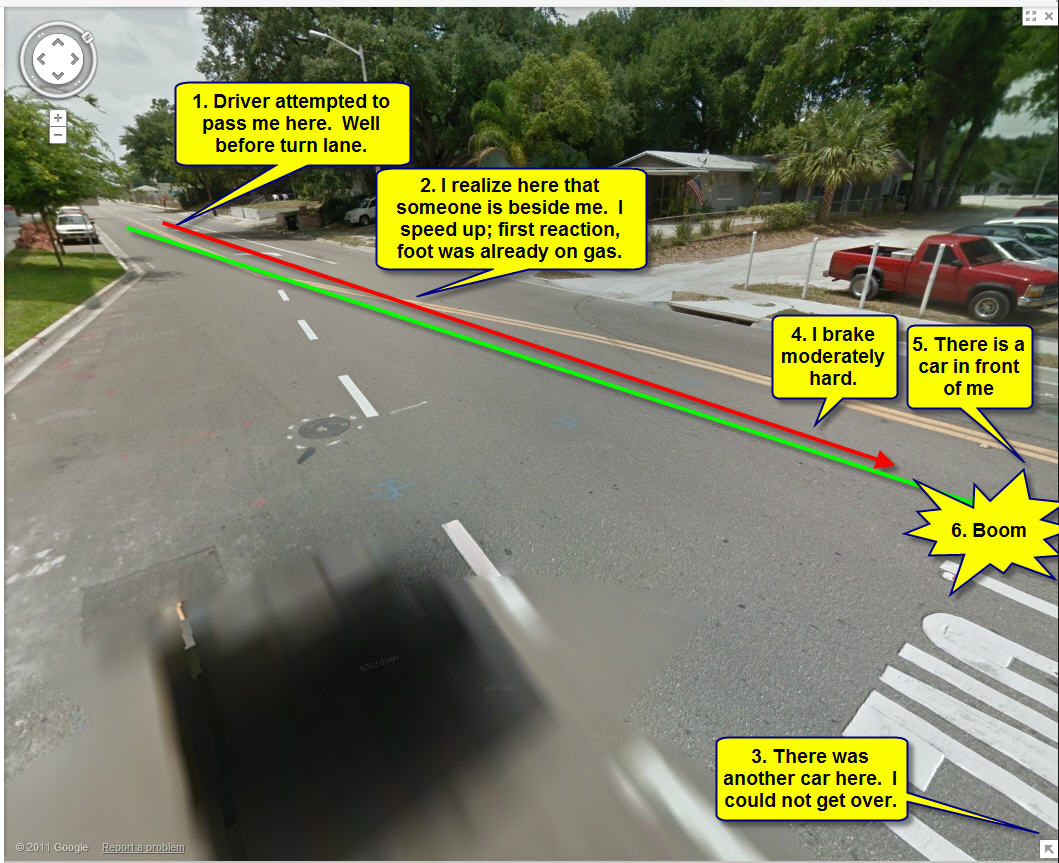
Below is a visual of the accident with numbered items for perusal.  Please click the image for a larger view.


click for larger view

click for larger view

The Terrorists Have Won

I didn’t watch any of the memorial services yesterday.   I didn’t tune into the radio and listen to the 9/11 commentary, ten years later.  When I was on the elliptical machine at the gym last night, I kept my headphones in my MP3 player instead of watching the solemn and respectful services.  I didn’t post, or re-post, and of the ubiquitous Facebook or Twitter 9/11 memorial posts.

I did sit at home and quietly reflect on the state of America ten years later.  I asked myself this question: Are we better off a decade later or not?  As a result of the tragedy that took so many lives and rocked our national identity to the core, are we better off as a nation?  Did we truly rise up as a people and confront the evil threatening our way of life or did we fail to do so?

I pondered long and hard.  I looked at it from different angles, and tried to use different perspective.  I continually came to the same conclusion:

The terrorists have won.

It was hard to admit, but as I realized the truth of that statement, I also recognized why I was reluctant to take part in the memorial services.  The memorial services were talking of victory, hope, of the fact that the 3,000 American lives lost were a tragedy but also a testament to the indomitable American will and way of life.  I couldn’t swallow that load of lies, and so I did not tune in.

The 3,000 lives lost were a huge tragedy and I do not feel America has done justice by those men and women.  In the ten years since 9/11 I have seen a constant erosion of the American way of life.  Our fear and distrust of ourselves, and the world, are at an all-time high.  We’ve bankrupted our nation trying to keep the war machine well-oiled.  Our civil liberties have been stripped from us.  Our government is completely gridlocked and ineffectual.

No; we are not better off.  We are worse off than we were before 9/11.   And we have no one to blame except ourselves.

Flag waving is not patriotism

Flag waving on Facebook

Flag waving on Facebook

I was talking to my daughter yesterday about the ubiquitous U.S. flags hanging from houses in our neighborhood.  She mentioned how patriotic most people were and we had a long discussion about how flag waving is not patriotism.  This ties into my earlier blog posts here and here.  She doesn’t really remember a pre-9/11 world.  She doesn’t remember how, before 9/11, only old vets had flags hanging from their houses.  But it did get me to thinking again.

It seems that we almost desperately engage in flag-waving since 9/11.  Visible, but meaninglessly shallow, displays of patriotism are not only looked upon with approval now, they are practically expected from us.  I suppose if we wave the flags hard enough we’ll convince ourselves that it’s OK to compromise the very ideals that made America great in the first place.

Breaking the Bank

U.S. military spending has almost doubled in the past ten years, with an over 80% increase since 2001.  Compared to other nations, we are far and away the biggest military spender on the playground.  And this spending is coming from mine and your tax dollars.  The global recession, the bank and auto bailouts, and out of control war spending have put our nation in a very vulnerable and dangerous position.

The total combined cost of the Iraq war, the Afghanistan war, and our operations in Pakistan have cost the U.S. taxpayers more than three trillion dollars!  And for what?  Are we more or less secure then we were 10 years ago?  This is money spent not only by the taxpayers, but by the very blood of our young men and women – fighting wars against a philosophy – Terrorism. You cannot win a war against an “ism” and so we perpetually fund the wars with the blood of our children.

The Illusion of Security

Gate Raped by the TSA

Gate Raped by the TSA

It was Benjamin Franklin who said “Anyone who trades liberty for security deserves neither liberty nor security.”  Like I said my blog post here, terrorism is a cancer on our society.  9/11 has left a scar on us as a nation – the smokey ruins of the Towers, now cleaned up but still a savage, ugly, scar across the face of America.  We live in a constant state of anxiety, afraid of a possible future, an eventuality that may or may not happen.  We fear another terrorist attack.  We strictly, and sometimes irrationally, attack anything that looks even remotely like terrorism.  We accept detaining or killing innocent people to cut the terror cancer from our lives – because they were close to terror but not necessarily of it.

We willingly give up our rights in order to fight this “ism.”  The Patriot Act gives away much of your right to privacy.  It’s legislation that violates privacy, free speech, and unlawful detention.  At the airport, we give up our Fourth Amendment rights and allow ourselves to get virtual strip searched, or “gate raped” so we can have an illusion of great safety as we fly.  We are being indoctrinated to believe and accept that “if you have nothing to hide you shouldn’t mind being searched.”

We are giving up the very freedoms we claim to have in this “land of the free” because we have let the terrorists beat us and, well, terrorize us.  We are acting irrationally.

Gridlock in Washington

The 9/11 terrorist attacks have forever altered our political climate and our political rhetoric as well.  Since 9/11 we have elected more and more militant and opinionated members to Congress.  The divide between Left and Right has become a chasm of almost insurmountable width.  We have completely lost our ability to compromise.  We have turned out government into a mass of Internet trolls.

We have a government unable to make even the most prudent and basic decisions, such as raising the debt ceiling to pay for bills already incurred.  They can’t help themselves, let alone the average man.  It’s no wonder we are in the middle of a jobs crisis right now.  These are the people who we have voted into office since 9/11.  This trolls, who put rhetoric before common sense, who put party before America, have completely derailed our political process – and it all started with the irrational, fear-based, backlash of 9/11.  We can blame the rise of uncompromising and short-sighted political rhetoric squarely on our shoulders.  The voters.  You and me.  We put these people in office.

How to Fight Terror

The terrorists have won.  This is why I had such a hard time participating in 9/11 memorials yesterday.  They have broken our spirit, ruined our economy, and turned America from the Land of the Brave into the Department of Homeland Security.  You don’t fight terrorism by changing your core values.  You fight terrorism by staying true to who you are.  Every day we give up our rights, allow fear to determine policy, and pay for unjust wars with the blood of our children we prove to the world that the terrorists can win.

When fighting terrorist, you cannot become the very thing you despise.  You cannot torture people.  You cannot wage war across the globe.  You cannot allow for “Acceptable losses” or “collateral damage.”  The only way to fight terrorism is to heighten your awareness level without infringing upon the rights of your citizens and live your lives as normal.  Don’t let the terrorists know they hurt you – because once they know they can bleed you they will be all over you again anda gain.

I was indeed somber and insightful on the 10-year anniversary of 9/11.  And I was sad.  I personally didn’t know anyone who died on 9/11, but I was sad for my fellow Americans and their families.  More, though, I was sad for the affect the terrorist attacks of 9/11 has had on our national psyche.  We have succumbed to fear, hatred, and intolerance.  We have become less than what we were.  And we didn’t have to.  We chose it.

American Politicians Take Lessons from Internet Trolls

American politics are a mess.  I have never been more disturbed and concerned about the future of our nation than I am right now.  Our politics have never been more partisan.  Our leaders have never been less willing to compromise.  Grand gestures and impossible ideology have become more important than doing the right thing.  Ad hominem attacks are the norm.    Red herrings are the rule of the day.  Trivialities and irrelevant criticisms are tossed out instead of meaningful dialogues.  Watching the campaign machines start to spin up, and witnessing the travesty of our debt ceiling fiasco a few short weeks ago, I realized something rather profound.  Our politicians are acting exactly like Internet Trolls.

(Note: be sure and answer the poll at the bottom of this post)

Internet trolls have been around for a long time and have been the focus of intense scrutiny.  Most netizens know what a troll is, but for the uninitiated, a troll is anyone who enters into a forum or discussion on the Internet with the intention of disrupting the conversation for no better reason than they can.  Trolls are everywhere; they lurk on Facebook, in IRC channels, on the Usenet, on forums and discussion boards everywhere.  Think about the last time you’ve seen a Facebook discussion “blow up” into 50+ responses that degenerated into emotional name calling or that started out as one topic and ended up on another.  Most likely, a troll was to blame.

Trolls love to disrupt your conversation

Trolls love to disrupt your conversation

What are the attributes of an Internet Troll?

  • They love the personal, or ad hominem, attack.  They attempt to negate your position or argument by talking about a perceived personality, lifestyle, or physical flaw.
  • They use red herrings, or irrelevant distractions, to shift the discussion away from the topic at hand.
  • They lack in-depth knowledge of subjects they speak about.  They consider themselves authorities by virtue of having an audience.
  • The use attention-seeking gimmicks.  They make ludicrous claims or statements or perform extreme actions to get others to pay attention to them and not the topic at hand.
  • They use intentionally inflammatory rhetoric to ignite already tense discussions and later claim they were misunderstood when confronted.
  • A complete unwillingness to compromise or concede any point of view except their own.
  • They use repetitive comments on trivial or irrelevant topics over and over again.

How do the traits of an Internet Troll compare to the politicians in our government?

  • Ad hominem attacks:  A perfect example is the fact that there is a general unspoken silent racist intolerance towards Obama because he is black.  Or the claims that Obama is not an American (although that is also a red herring).  These are personal attacks that have nothing to do with his policies or his ability to be the leader of this nation.  The fact that this red herring and associated personal attacks have distracted us for so long, and continues to do so, speaks to the power of the troll.
  • Red herrings: The debate about Obama’s childhood Muslim connections is a red herring.  This distraction has continually plagued the President and has no bearing on his appropriateness as a leader.  None.  This is a red herring designed to play on the intolerance and fears of the fundamentalist Christians in our nation.  And it works.  Devoid of critical thought, an irrelevant and trivial past association becomes a red herring that distracts us for months.
  • Lack of in-depth knowledge:  Michelle Bachmann is promising $2.00 gas if she is elected.  Gas was about $1.79 a gallon when Obama was elected and she claims she will get us back to that figure, but has presented no plan to make it so and has shown no understanding of the industry and the reasons why gas prices fluctuate and are growing.  Even more drilling in the U.S. will not significantly lower gasoline prices.  So how is she going to do it?
  • Attention-Seeking Gimmicks:  Presidential hopeful Rick Perry all but physically threatened Federal Reserve Chairman Ben Bernake, saying his actions would be “almost treasonous” and they “would treat him pretty ugly in Texas.”  This statement catapulted him into the media spotlight and was designed as nothing more than a gimmick to let the Tea Party know he was giving them lip service.
  • Intentionally inflammatory remarks:  See above about Rick Perry.
  • Unwillingness to compromise.  There are too many examples to list here.  I’ll only mention that the debt ceiling fiasco is a perfect example of this.

The list is incomplete, so I encourage you all to post comments on this thread with more examples and troll characteristics and comparable political behavior.

What is the Source of Political Trolling?

I have been dealing with Internet trolls for years.  I have been a troll myself – I think most of us on the interwebz have been guilty of trollish behavior from time-to-time.  I learned to expect this type of behavior from people on the Internet because of the pseudo-anonymity of people who post, but I was shocked by my realization that our national public figures are acting like these Internet trolls.

The Source of most Political Trolling

The Source of most Political Trolling

I was shocked until I took it one step further and looked for the reasons why we find it so acceptable for our politicians to be trolls.  I didn’t have far to look what I consider to be the preeminent reason.  The past decade has been characterized by the Ascendancy of Fox News and the vitriolic personalities on the network who are the epitome of trolls and the bane of reasoned and cultured discourse.

Fox News has done a superb job of focusing on irrelevancy, preying on the fears of its constituents, and completely erasing the line between facts, news, propaganda, and opinion.  Day in and day out it’s filled with so-called political commentary that is really nothing more than sensationalist opinion meant to incite a high emotional response, detract from real issues at hand, and drive a very specific political agenda.  The commentators, pundits, and political figures who back Fox news or who wish to gain the attention of the listeners and viewers have turned to ever more inflammatory and derogatory language and positions to make themselves appear more passionate and able to lead than the man (or woman) with whom they spar politically.

There is an entire cable network that churns out trolls and trollish behavior at an alarming rate.  It’s incredibly easy to do, too.  A troll need not be an expert in anything.  A troll only need topple the man who is an expert.  A troll needs only a strong opinion, a decent vocabulary, and a simmering anger that others will confuse for passion.

A troll is designed not to build, but to destroy

A troll is designed not to build, but to destroy.  The sad thing is that a political troll will confuse his actions with patriotism – a self-rationalization that allows him to justify the abhorrent behavior he displays the precarious positions he stands for.  A troll will play the fiddle while Rome burns, satisfied and content that they have done something positive when all that they truly achieved was the lighting of the fire that burned a civilization.

Text says it all.

How do you deal with trolls?  On the Internet we’ve learned only one surefire method of getting rid of trolls: don’t feed them.  Ignore them.  Don’t bite when they attack.  Don’t acknowledge their existence.  Don’t allow them to degrade or ruin a conversation.  Any comment, any reaction, any acknowledgment of the troll only feeds the troll and makes it more likely that it will hang around and continue to harass and disrupt the discourse.   This is extremely difficult to do and takes the willing cooperation of everyone involved in the discussion.  Everyone must ignore the troll.  No one can feed him.  If even a single person feeds the troll, you have to start all over again.

Vote for Moderation; Champion Compromise

You can imagine how rare it is to successfully fend off a troll.  Trolls specialize in baiting, flaming, and attacking.  They excel in divide and conquer.  They live to destroy and they are very good at it.  Get ten people on a discussion on the Internet and a troll will appear.   Similarly, in our current political environment, it will take all of us, or a vast majority of us, to reject the sensationalist propaganda, hate filled ad hominem attacks, repugnant red herrings, and general uncivilized behavior of our current  politicians.  Both Left and Right.  We have to, as a nation, stop embracing the short-sighted, destructive, and trollish behaviors that have become the hallmark of our political system lately.  We have to vote for moderation, we have to champion compromise.  We have to elect leaders who understand the difference between rhetoric and reality and are willing to do the right thing for America, even if it means they are only single-term politicians.

I will say this in closing.  President Obama is clearly not a troll.  If he were on an Internet discussion board or engaged in a Facebook debate, he would be the poster who posts intelligent, well-reasoned arguments, who works with everyone to find common ground, and is willing to listen to alternate points of view.  This is the centerpiece of his Presidency in my opinion – intelligent discourse.  Obama is the lone rationalist trying to wade through a sea of intolerant, racist, anti-science, distraction-loving, trolls.  This is why I will vote for him again; he’s one of the few political figures today who does not engage in trollish behavior.  We should all learn a lesson from his example.

(special thanks to my son, Christopher, for making me the trollface flag picture featured above)